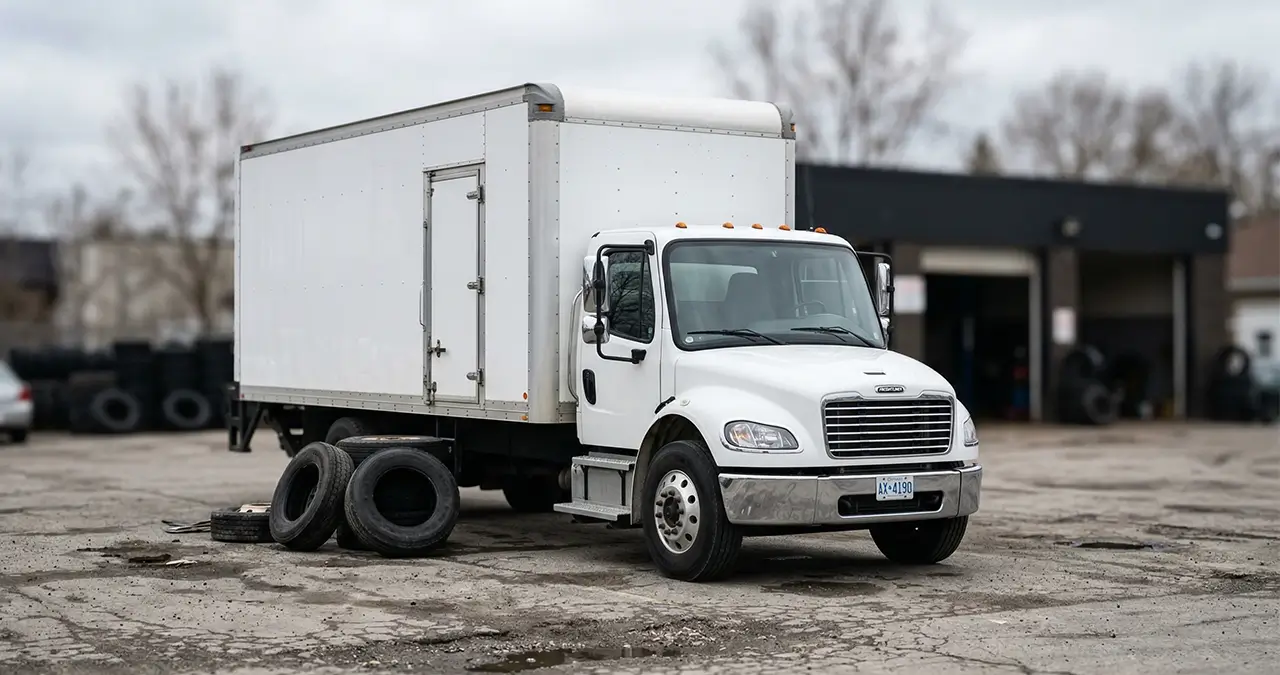
What is a CVOR, and why should you care? A single missing certificate can shut down your entire fleet. That’s the reality of Ontario’s CVOR program, and most small operators don’t find out until a roadside officer asks for paperwork they’ve never heard of.
CVOR stands for Commercial Vehicle Operator’s Registration. It’s a safety monitoring system run by Ontario’s Ministry of Transportation (MTO) that tracks every collision, conviction, and roadside inspection tied to your operation. If you run trucks over 4,500 kg in this province, you’re required to have one. The fee is $287 and the fines for operating without it start at $310 per vehicle (Ontario.ca).
We’ve been performing commercial vehicle inspections at our shop in London, Ontario for over 35 years. In that time, we’ve watched dozens of owner-operators and small fleet managers learn about CVOR the hard way. This guide answers the question “what is a CVOR” in plain language and covers everything you need to know: who needs one, how to get one, what the safety ratings mean, and how to keep your record clean.
Key Takeaways
- Ontario requires CVOR for all trucks over 4,500 kg, buses with 10+ seats, and tow trucks of any weight (Ontario.ca)
- A CVOR certificate costs $287 and applications are now processed online through the MTO portal
- Your CVOR safety rating is public – insurers, shippers, and customers can all see it
- Fines for non-compliance range from $310 per vehicle (display violations) to $50,000 (wheel separation)
- 85% of Canadian trucking companies operate fewer than 20 trucks (World Metrics, 2026), and many don’t realize CVOR applies to them
This FAQ covers:
- What is a CVOR and how it works – the basics of Ontario’s commercial vehicle safety system
- Who needs one – the 4,500 kg rule and common surprises
- How to apply – the new online process and costs
- Safety ratings – what they mean and why they matter
- Penalties – what happens when you’re not compliant
- Protecting your rating – practical steps from a repair shop perspective
What Is a CVOR in Ontario?
So what is a CVOR exactly? A CVOR (Commercial Vehicle Operator’s Registration) is a mandatory certificate that functions as your fleet’s safety scorecard with the Ontario Ministry of Transportation (Ontario.ca). Every commercial operator in the province gets one, and the MTO uses it to track your safety performance over time.
Think of it like a credit score, but for your trucks. The MTO records every collision your vehicles are involved in, every driver conviction under your CVOR number, every roadside inspection result, and every facility audit outcome. That data rolls into a violation rate that determines your safety rating.
Here’s the part that catches people off guard. Your CVOR record isn’t private. It’s available to the public, which means insurance companies review it at renewal time. Shippers check it before booking loads. Potential customers look it up. A bad record doesn’t just mean government penalties. It affects your bottom line in ways most operators don’t anticipate.
From our shop: We’ve worked with fleet operators in London who didn’t realize their CVOR was accumulating points from minor driver infractions. By the time they noticed, their insurance renewal came in 40% higher than the previous year. Checking your CVOR even once a quarter can prevent that kind of surprise.
Every infraction stays on your record for a minimum of two years from the offence date (Ontario Traffic Tickets, 2024). That means a string of bad inspections in 2026 will still be dragging your rating down in 2028.
Approximately 4 million commercial motor vehicle inspections are conducted every year across North America through the CVSA program (CVSA, 2025). Ontario participates fully, and every one of those inspections feeds data back to your CVOR.
Does Your Truck Need a CVOR?
If your truck’s gross weight exceeds 4,500 kg (9,920 lbs), you need a CVOR. That’s the threshold, and Ontario applies it broadly (Ontario.ca). Eighty-five percent of Canadian trucking companies operate fewer than 20 trucks (World Metrics, 2026), and many of those smaller operators don’t realize their vehicles qualify.
Specifically, you need a CVOR if you operate any of the following in Ontario:
- Trucks with a registered gross weight (RGW) or actual weight over 4,500 kg
- Buses with seating capacity for 10 or more passengers
- Tow trucks of any weight, including flatbed tilting vehicles used for towing
- Concrete pumps and mobile cranes used on highways
- Vehicles plated in Ontario, the United States, or Mexico that meet the weight threshold
The weight calculation is where the surprises happen. Ontario uses whichever number is highest: your total gross weight, registered gross weight, or the manufacturer’s gross vehicle weight rating (GVWR). You don’t get to pick the most favorable one.
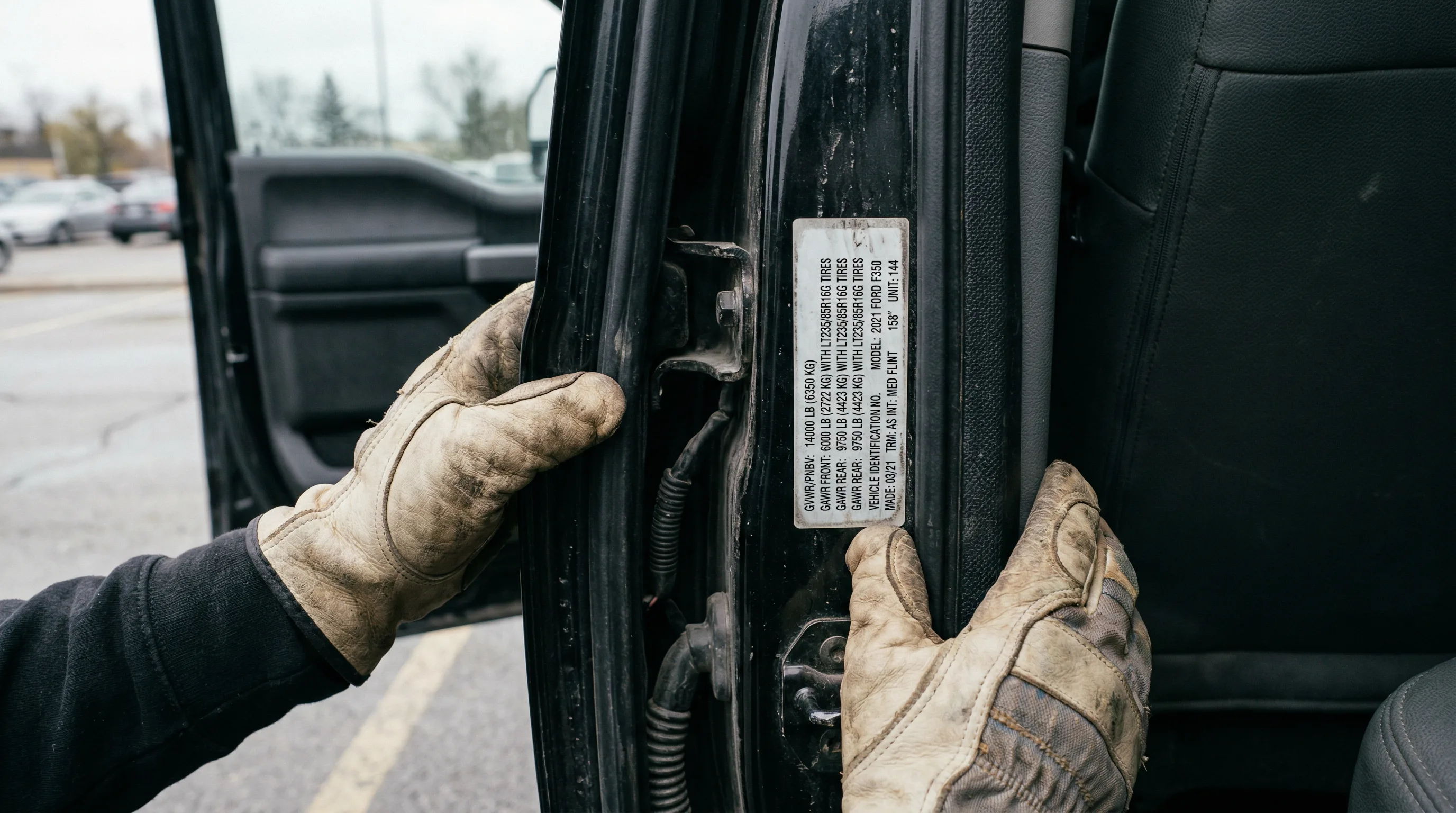
Quick Reference: Does Your Vehicle Need a CVOR?
| Vehicle Combination | Typical Combined GVWR | Needs CVOR? | What’s Required |
|---|---|---|---|
| Half-ton pickup + light utility trailer | ~3,800 kg | Usually no | Standard rules |
| 3/4-ton pickup + loaded equipment trailer | ~5,400 kg | Yes | CVOR, annual inspection, daily checks |
| F-350/Ram 3500 + horse trailer | ~5,800 kg | Yes | CVOR, annual inspection, daily checks |
| Class 6 straight truck (single unit) | ~11,000 kg | Yes | Full compliance + ELD |
| Class 8 tractor-trailer | ~36,000 kg | Yes | Full compliance + ELD + speed limiter |
From our shop: We see this surprise people constantly. Landscapers with a 3/4-ton pickup and a loaded utility trailer. Contractors hauling materials on a flatbed. Horse owners with a heavy stock trailer. None of them thought they were running a “commercial vehicle” until a roadside inspection said otherwise.
For more on what Ontario considers a commercial vehicle and the full compliance requirements, see our Ontario commercial vehicle compliance guide.
Who Is Exempt from CVOR?
The exemption list is shorter than most people expect. Ontario exempts only a narrow set of vehicle categories from CVOR requirements (Ontario.ca).
You don’t need a CVOR for:
- Vehicles plated in other Canadian provinces or territories (they’re covered by their home province’s carrier profile)
- Personal-use pickup trucks that meet ALL of these conditions: unmodified manufacturer’s box, no commercial cargo, no compensation for use, and GVWR of 6,500 kg or less
- Ambulances, fire trucks, and hearses
- Buses leased short-term (30 days or less) for personal use
- Motor homes used for personal purposes
The personal-use pickup exemption is the one that trips people up the most. You need to meet every single condition. Throw a few bags of mulch in the bed for a landscaping client? That’s commercial cargo. Get paid to haul a friend’s furniture? That’s compensation. Miss any one condition and you’re back in commercial territory, and the CVOR requirement applies.
Key distinction: The 4,500 kg CVOR threshold and the personal-use exemption are two separate tests. Your pickup could weigh under 4,500 kg solo but still need a CVOR when you hitch a loaded commercial trailer that pushes the combined weight over the line.
How Do You Get a CVOR in Ontario?
As of November 1, 2024, the CVOR application process moved online. The old in-person knowledge test at DriveTest centres was eliminated entirely by May 1, 2025 (Miller Thomson, 2024). The total cost is $287.00 HST included, broken down as $255 for processing and $32 for the learning and assessment fee (Ontario.ca).
Here’s the step-by-step process:
Step 1: Gather Your Documentation
For individuals and sole proprietors:
- Ontario driver’s licence number (or copy if from another province)
- Proof of liability insurance under Ontario’s Compulsory Automobile Insurance Act
- Completed Consent and Authorization form
For incorporated companies:
- Driver’s licence numbers for all corporate officers
- Articles of Incorporation, Amalgamation, Amendment, and Master Business Licence
- Proof of liability insurance
- Completed Consent and Authorization form
Step 2: Submit Your Application
Apply through the MTO’s online portal. Sole proprietors and incorporated companies can apply online. General partnerships (limited to 2 partners) must download the form and mail it to the MTO.
Step 3: Pay the $287 Fee
The fee covers both processing and the new online learning module. Payment is made during the application.
Step 4: Complete the Online Learning and Assessment
After your application is processed, the MTO sends instructions for registering for the online course. The course covers 16 topics including vehicle weights and dimensions, driver management, vehicle maintenance, electronic logging devices, dangerous goods, load securement, and hours of service.
Important: You have 6 months to complete and pass the online learning assessment. If you don’t pass within that window, you must restart the entire application process and repay all fees.
Step 5: Receive Your Certificate
Once you pass, the MTO issues your CVOR certificate. You’re required to carry a copy in every commercial vehicle operating under your certificate and display your CVOR number on each qualifying vehicle.
The knowledge assessment is required when you’re a first-time applicant based in Ontario or when your CVOR has been expired for more than three years. Renewals and transfers don’t require retaking it.
How Do CVOR Safety Ratings Work?
Every CVOR holder receives a safety rating based on their violation rate, a rolling 24-month calculation that factors in collisions, driver convictions, and out-of-service inspection results (CVOR.ca). Ontario assigns one of four primary ratings, and each one has real consequences for your operation.
The violation rate isn’t a simple count of infractions. The MTO weighs your record against your fleet size and annual mileage. A 50-truck fleet with two violations is different from a 3-truck operation with the same number. Ontario CVOR Safety Rating Thresholds Horizontal bar chart showing Ontario CVOR safety rating violation rate thresholds. Excellent rating requires 15% or less violation rate. Warning letter issued at 35%. Facility audit triggered at 50%. Satisfactory rating maximum is 70%. Conditional rating above 70%. Unsatisfactory rating at 100% or above, resulting in suspension. Source: CVOR.ca, Ontario Ministry of Transportation. Ontario CVOR Safety Rating Thresholds Violation Rate (%) — Lower is better 0% 25% 50% 75% 100% Excellent ≤ 15% Warning Letter 35% Facility Audit 50% Satisfactory ≤ 70% Conditional > 70% Unsatisfactory > 100% SUSPENDED Source: CVOR.ca, Ontario Ministry of Transportation Source: CVOR.ca, Ontario Ministry of Transportation
Safety Rating Breakdown
| Rating | Violation Rate | Collision Rate | Key Requirements |
|---|---|---|---|
| Excellent | 15% or less | 10% or less | 24+ months operating, facility audit score 80%+ |
| Satisfactory | 70% or less | Not specified | 6+ months operating, passed MTO facility audit |
| Satisfactory-Unaudited | 70% or less | Not specified | No facility audit completed yet |
| Conditional | Above 70% | Not specified | Failed audit, high violations, or linked to another conditional CVOR |
| Unsatisfactory | Above 100% | Not specified | Operating privileges suspended across Canada |
The MTO doesn’t wait until you hit Unsatisfactory to intervene. At a 35% violation rate, you’ll receive a warning letter. At 50%, a facility audit becomes likely (CVOR.ca). If you’re placed on Conditional status, you need to bring your violation rate below 60% to upgrade, and you’ll spend a minimum of 6 months at Conditional regardless.
The hidden cost: Most CVOR explainers focus on government penalties. But the bigger financial hit is insurance. Your carrier reviews your CVOR record at every renewal. A string of violations can push premiums up by thousands of dollars. Some insurers will drop you altogether. And shippers increasingly check CVOR ratings before booking loads. A Conditional rating doesn’t just mean MTO scrutiny. It means lost business.
An Unsatisfactory rating is the worst outcome. Your operating privileges are suspended throughout Canada, not just Ontario. Getting reinstated requires bringing the violation rate well below 100% and potentially going through a full facility audit.
What Happens If You Operate Without a CVOR?
Operating a qualifying commercial vehicle without a CVOR is a Highway Traffic Act violation. Penalties can include fines as high as $50,000, driver’s licence suspension, and jail time (Traffic Paralegal Services, 2024). The severity depends on the offence, but even minor violations add up fast.
Here’s how the penalties break down:
Display violations: Failing to show your CVOR number on a qualifying vehicle is one of the most common citations. Improper CVOR display was cited in 28% of commercial vehicle inspections that resulted in violations, making it a top-5 compliance failure in Ontario (Traffic Paralegal Services, 2024). The fine starts at $310 per vehicle.
CVOR points: Every offence carries 0 to 5 CVOR points depending on severity. Points stay on your record for 2 years from the offence date. Accumulate enough and the MTO will initiate a facility audit, which can lead to fleet size limitations, plate seizures, or full suspension.
Escalation for critical violations: Wheel separation carries fines from $2,000 to $50,000 with absolute liability. That means you’re responsible even if you didn’t know about the problem. Critical defects can also trigger a minimum 15-day vehicle impoundment.
Out-of-service orders: At a roadside inspection, an officer can place your vehicle or driver out of service on the spot. Your truck sits on the shoulder until the issue is resolved. The 2025 CVSA International Roadcheck found that 18.1% of inspected vehicles had out-of-service violations, with brake issues accounting for 24.4% of all vehicle out-of-service violations (CVSA, 2025).
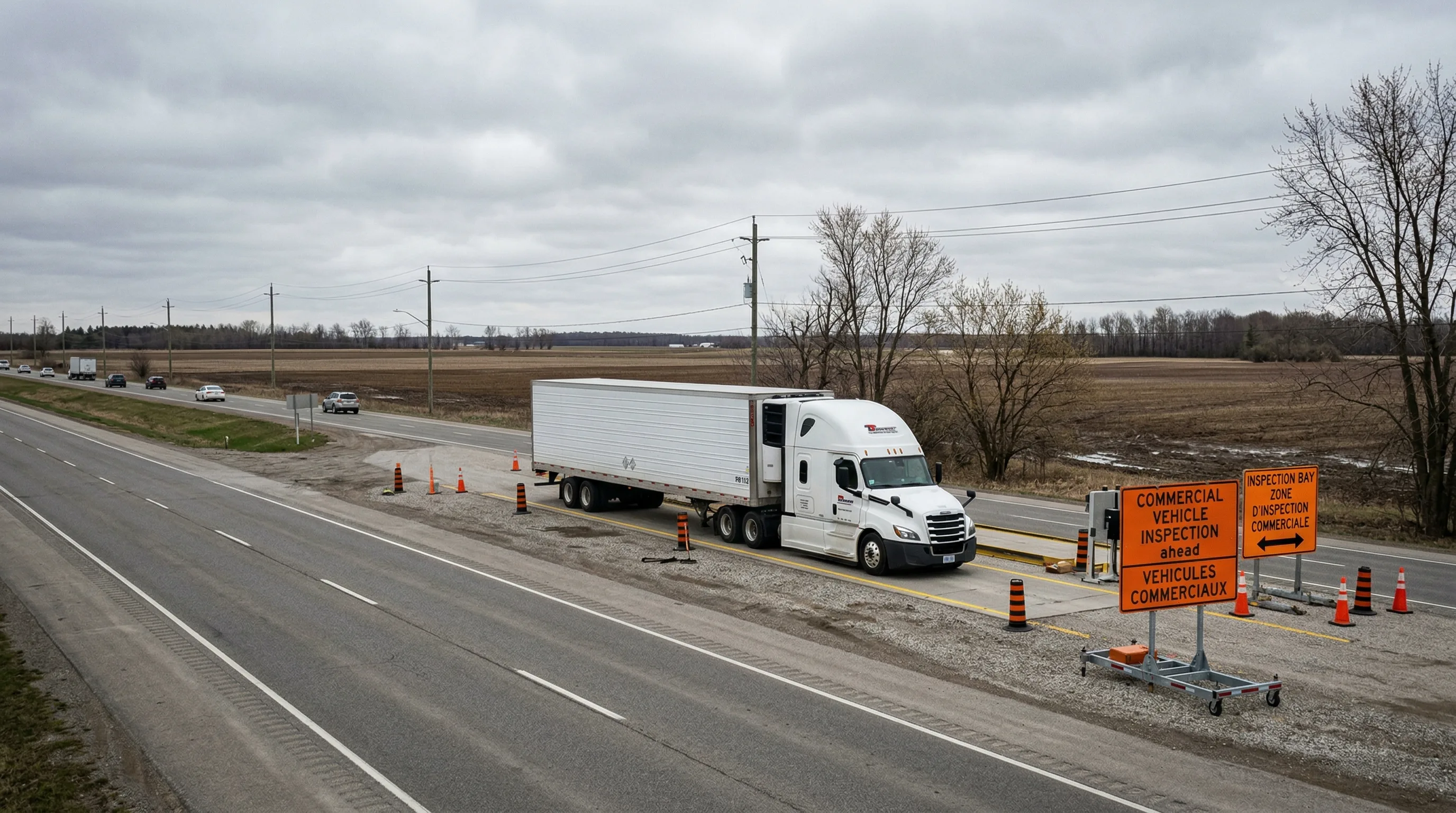
The financial math is straightforward. A $310 display fine on every vehicle in a 10-truck fleet is $3,100. Add insurance premium increases from the violation points, potential out-of-service downtime at $700 to $1,200 per day, and the cost of a facility audit response, and a few missing stickers can easily become a five-figure problem.
How Can You Protect Your CVOR Rating?
The most effective way to protect your CVOR rating is to prevent violations before they happen. Brake violations alone accounted for 24.4% of all vehicle out-of-service violations during the 2025 CVSA International Roadcheck (CVSA, 2025). Most of those failures are detectable during routine maintenance, well before a roadside officer finds them.
Here’s what works in practice:
Check your CVOR record quarterly. You can request your record from the MTO at any time. Don’t wait for a renewal or an audit letter to find out what’s on it. Catching a problem early gives you time to address it before it compounds.
Stay current on annual safety inspections. Ontario requires an annual inspection for every commercial vehicle over 4,500 kg. These are performed by licensed DriveON VIC technicians at facilities like ours. A thorough annual inspection catches the brake, lighting, and suspension issues that roadside officers look for. For the full checklist, see our annual safety inspection guide.
Enforce daily pre-trip inspections. Every driver should complete a written pre-trip inspection within 24 hours of driving. Brakes, tires, lights, steering, coupling devices, load securement. It takes 15 minutes and it’s the single cheapest way to prevent an out-of-service violation.
Train your drivers on HTA requirements. Many CVOR points come from driver behaviour, not vehicle condition. Speeding, hours-of-service violations, and distracted driving all go on your CVOR. Make sure your drivers understand that their tickets affect your business.
Build a relationship with a licensed inspection facility. Regular maintenance at a shop that knows commercial vehicles means problems get caught in the bay, not on the highway. That’s the difference between a $200 brake adjustment and a $310 fine plus CVOR points plus a day of downtime.
From our shop: After 35 years of performing commercial vehicle inspections in London, Ontario, the pattern is clear. Operators who come in for scheduled maintenance and stay on top of their annual inspections almost never have CVOR problems. The ones who show up only when something breaks are the ones getting warning letters.
Frequently Asked Questions
What is a CVOR certificate cost in Ontario?
A CVOR certificate costs $287.00 HST included. That breaks down to $255 for the processing fee and $32 for the new online learning and assessment fee (Ontario.ca). This is a one-time application cost. You don’t pay an annual renewal fee as long as you keep your information current and maintain compliance.
Can I apply for a CVOR online?
Yes. Since November 1, 2024, Ontario accepts CVOR applications through the MTO’s online portal. The old in-person knowledge test at DriveTest centres was fully eliminated by May 1, 2025 (Miller Thomson, 2024). Sole proprietors and incorporated companies can complete the entire process online. General partnerships must still submit by mail.
Does a CVOR expire?
A CVOR certificate doesn’t have a set expiration date. It remains valid as long as you keep your information up to date and maintain your safety requirements. However, if your CVOR lapses for more than three years, you must reapply from scratch and complete the online learning assessment again, paying all fees a second time.
Does a pickup truck need a CVOR?
Only if the combined GVWR of the truck plus any trailer exceeds 4,500 kg and it’s used for commercial purposes. A personal-use pickup with an unmodified manufacturer’s box, no commercial cargo, no compensation for use, and a GVWR of 6,500 kg or less is exempt (Ontario.ca). All four conditions must be met. Miss one and the exemption doesn’t apply.
Is my CVOR safety rating public?
Yes. Your CVOR safety rating is available to anyone who requests it. Insurance companies check it at renewal. Shippers use it to vet carriers before booking loads. Potential customers can look it up. A poor rating doesn’t just mean MTO penalties. It directly affects your ability to win business and keep your insurance premiums manageable (Ontario.ca).
Related Resources
Explore these resources for deeper coverage of Ontario commercial vehicle compliance:
- Ontario Commercial Vehicle Compliance: Complete 2026 Guide – Our comprehensive pillar guide covering CVOR, annual inspections, DriveON, and all compliance requirements
- Ontario.ca: CVOR Overview – The official MTO page on CVOR requirements and responsibilities
- Ontario.ca: Get a CVOR Certificate – Official application page with current fees and documentation requirements
- CVSA International Roadcheck Results – Annual inspection blitz results showing the most common violations across North America
Still Wondering What Is a CVOR and Whether You Need One?
If you’re not sure whether your vehicle needs a CVOR, or if you need an annual safety inspection to stay compliant, give us a call. London Custom Truck & Car Repair has been performing commercial vehicle inspections in London, Ontario for over 35 years. We’re a licensed DriveON inspection facility and we work with owner-operators and fleet managers across Southwestern Ontario every day.
Phone: [519-452-3170] | Location: London, Ontario | Book an inspection