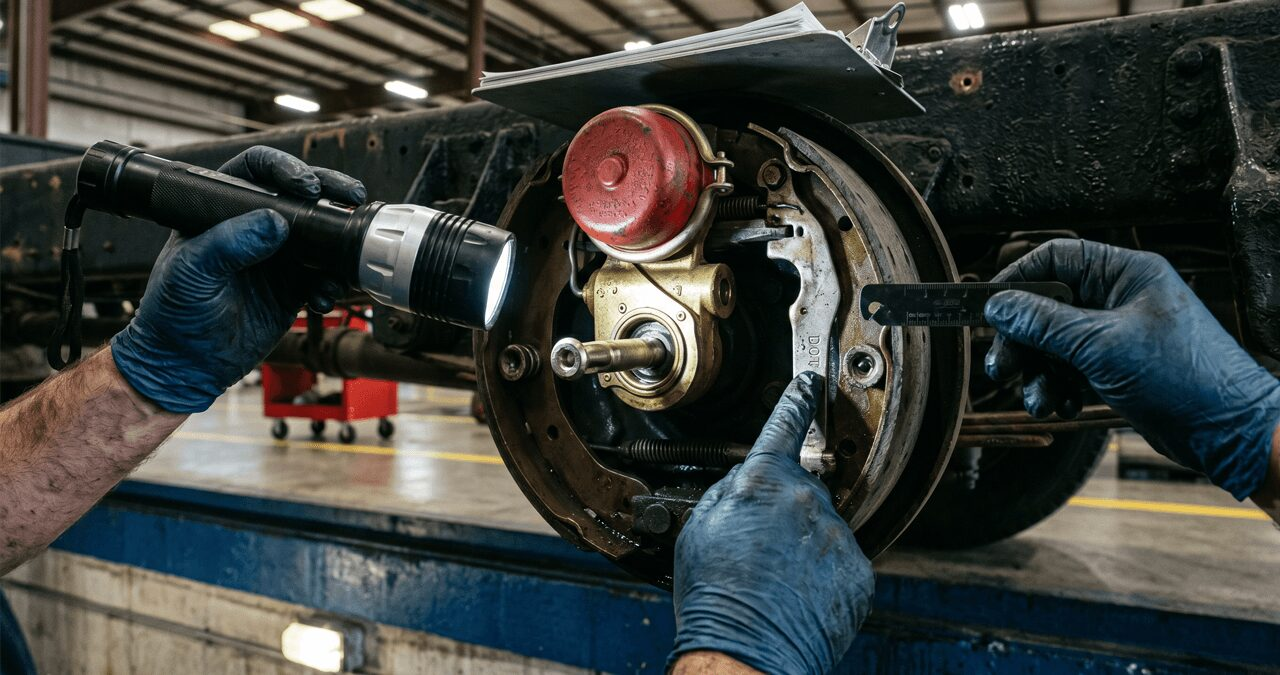
Your annual safety inspection is the single most important compliance requirement for Ontario trucks — and most operators underestimate what it involves. Last year, brake defects alone accounted for more than 40% of all commercial vehicle out-of-service violations across North America (CVSA, 2025). That’s not a lighting issue or a cracked mirror. That’s the system that stops a 36,000 kg truck on a highway, and it’s failing at a rate that should make every operator pay attention.
Ontario requires an annual safety inspection for every commercial vehicle over 4,500 kg. The inspection follows Canada’s National Safety Code Standard 11, Part B, and it covers 12 major systems. But the government documentation reads like it was written for lawyers, not truckers. What actually gets checked? What do most trucks fail on? And how do you avoid showing up to your inspection only to get sent home with a repair list?
We’ve been performing these inspections at our shop in London, Ontario for over 35 years. This is the checklist we wish every operator had before they booked an appointment.
Key Takeaways
- Ontario’s annual inspection covers 12 major systems under NSC Standard 11, Part B — brakes, tires, steering, suspension, lights, exhaust, frame, coupling, fuel, glass, emergency equipment, and general items
- Brake defects cause 40%+ of all out-of-service violations; tire issues cause another 21.4% (CVSA, 2025)
- Fines for operating without a valid inspection sticker range from $400 to $20,000, plus up to 30 days imprisonment (Ontario HTA)
- A pre-inspection check at your own yard can catch 80% of common fail points before you spend money on shop time
- Every failed inspection hits your CVOR record and stays there for two years
Who Needs an Annual Safety Inspection in Ontario?
Eighty-five percent of Canadian trucking companies operate fewer than 20 trucks (World Metrics, 2026), and a surprising number of those operators don’t realize Ontario’s annual inspection requirement applies to them. If your vehicle’s gross weight exceeds 4,500 kg, you need one. No exceptions.
Ontario mandates annual safety inspections for all trucks, trailers, and converter dollies — alone or in combination — with a total gross weight, registered gross weight, or manufacturer’s GVWR exceeding 4,500 kg (Ontario.ca). That includes the landscaper with a loaded 3/4-ton pickup and trailer. It includes the contractor hauling a flatbed. And it definitely includes every Class 6 through Class 8 truck on the road.
The inspection is valid for 12 months. When your vehicle passes, you get an inspection certificate, an inspection record, and a sticker (decal) that displays the month and year of inspection. That sticker goes on the vehicle and stays visible. No sticker, no driving.
Certain vehicles need semi-annual inspections — every six months instead of twelve. School buses fall into this category, along with accessible vehicles and some other specific types. But for most commercial trucks and trailers, it’s once a year.
For full details on who qualifies and what Ontario considers a commercial vehicle, see our complete guide to Ontario commercial vehicle compliance.
What Standard Does Ontario Use? NSC 11 Part B Explained
Ontario’s annual inspections follow Canada’s National Safety Code Standard 11, Part B — a federal standard that every province uses as the baseline for periodic motor vehicle inspections (Ontario.ca). During the 2025 CVSA International Roadcheck, enforcement personnel conducted 56,178 commercial vehicle inspections across North America in just 72 hours (CVSA, 2025). That gives you a sense of the scale and seriousness behind this standard.
NSC 11 Part B isn’t the same as your daily trip inspection. Your daily check — Schedule 1 under Ontario Regulation 199/07 — is a walk-around that drivers do every 24 hours. It catches obvious problems. The annual inspection is a full mechanical examination performed by a licensed Motor Vehicle Inspection Technician at a licensed inspection station. It goes deeper. Much deeper.
The standard classifies every potential defect as either major or minor. Here’s the critical distinction: if the inspector finds a major defect, your vehicle cannot be operated until that defect is repaired. Not “fix it when you get a chance.” Not “schedule it for next week.” The truck stays parked.
What most people get wrong: Many operators confuse roadside inspections with annual facility inspections. A roadside inspection is a spot check by an enforcement officer — they can’t pull your wheels. An annual inspection at a licensed facility includes pulling wheels, measuring brake components, and getting under the vehicle. It catches problems a roadside check never would.
Minor defects get recorded and need repair within a reasonable timeframe. But they won’t ground your truck on the spot. The difference between a minor and major defect can be a few millimetres of brake lining. That’s why precision matters.
The Complete Annual Safety Inspection Checklist — All 12 Categories
The CVSA’s 2025 Roadcheck found that brake systems and tires together account for more than 61% of all vehicle out-of-service violations (CVSA, 2025). But inspectors don’t stop at brakes and tires. Here’s every system they examine during an Ontario annual safety inspection under NSC 11 Part B.
1. Braking System
This is where most inspections get serious. The inspector will:
- Measure brake pad and brake-shoe lining thickness (minimum 1.7 mm per NSC 11B) (OTA)
- Remove wheels and drums to inspect friction surfaces when any brake defect is found
- Check air brake chambers, slack adjusters, and pushrod stroke
- Test the parking brake and spring brake control valve
- Verify ABS is operational on all vehicles originally equipped with it
- Inspect all brake lines, hoses, and fittings for leaks or damage
If a single brake shows a defect, the wheel comes off. Every time. No shortcuts.
2. Tires and Wheels
Tire violations were the second most-cited out-of-service violation in 2025, accounting for 21.4% of all OOS findings (CVSA, 2025). Inspectors check:
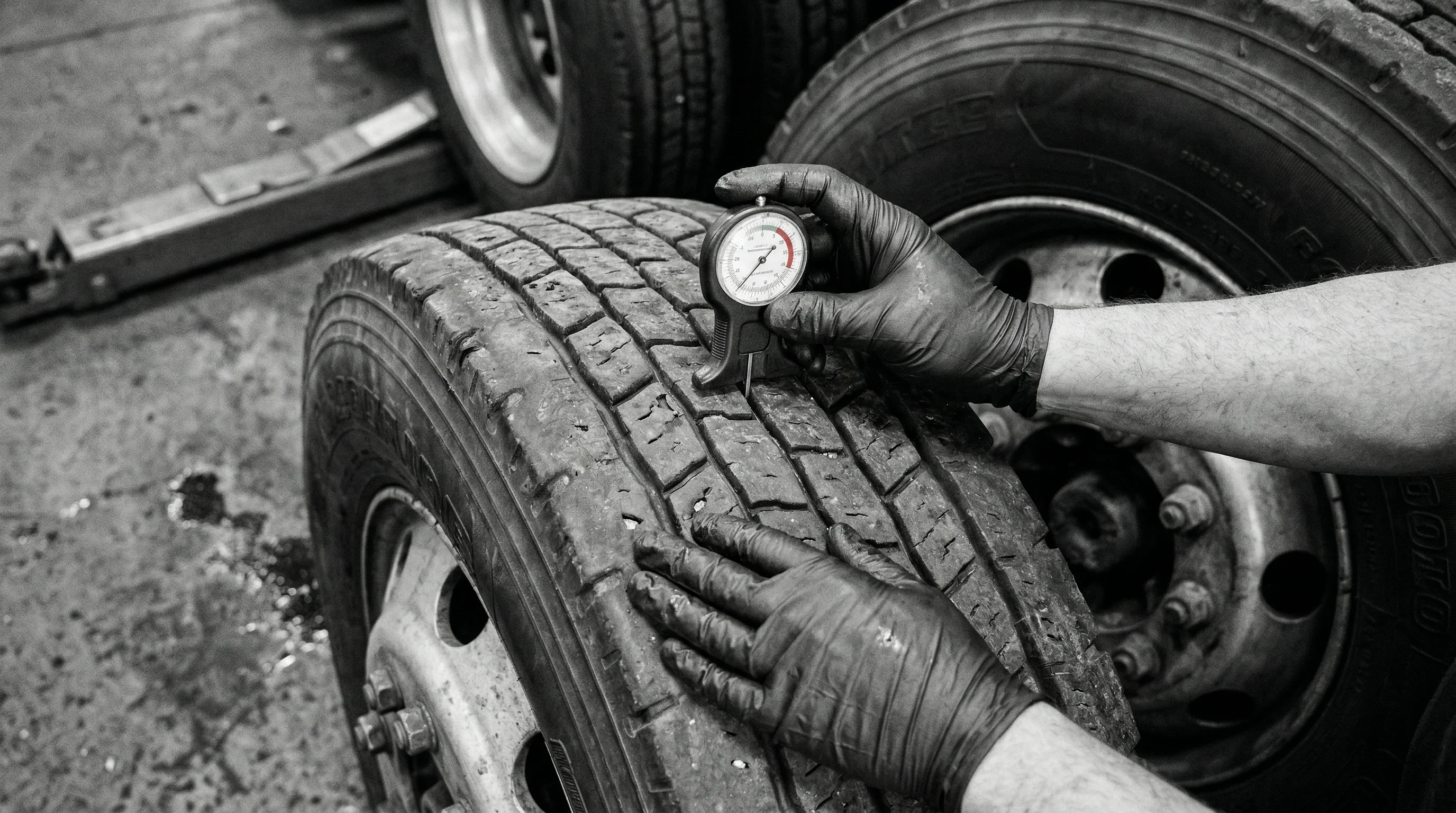
- Tread depth across the full width of the tire
- Sidewall condition — cuts, bulges, exposed cords
- Proper inflation (under-inflation is a major defect)
- All lug nuts present and properly torqued
- Rim condition — cracks, bends, weld repairs
- Mismatched tire sizes on the same axle
3. Steering System
- Steering wheel play/looseness (excessive free play is a major defect)
- Tie rod ends and ball joints for wear
- Power steering fluid levels and leaks
- Steering gear box mounting and condition
- Steering column and U-joints
4. Suspension
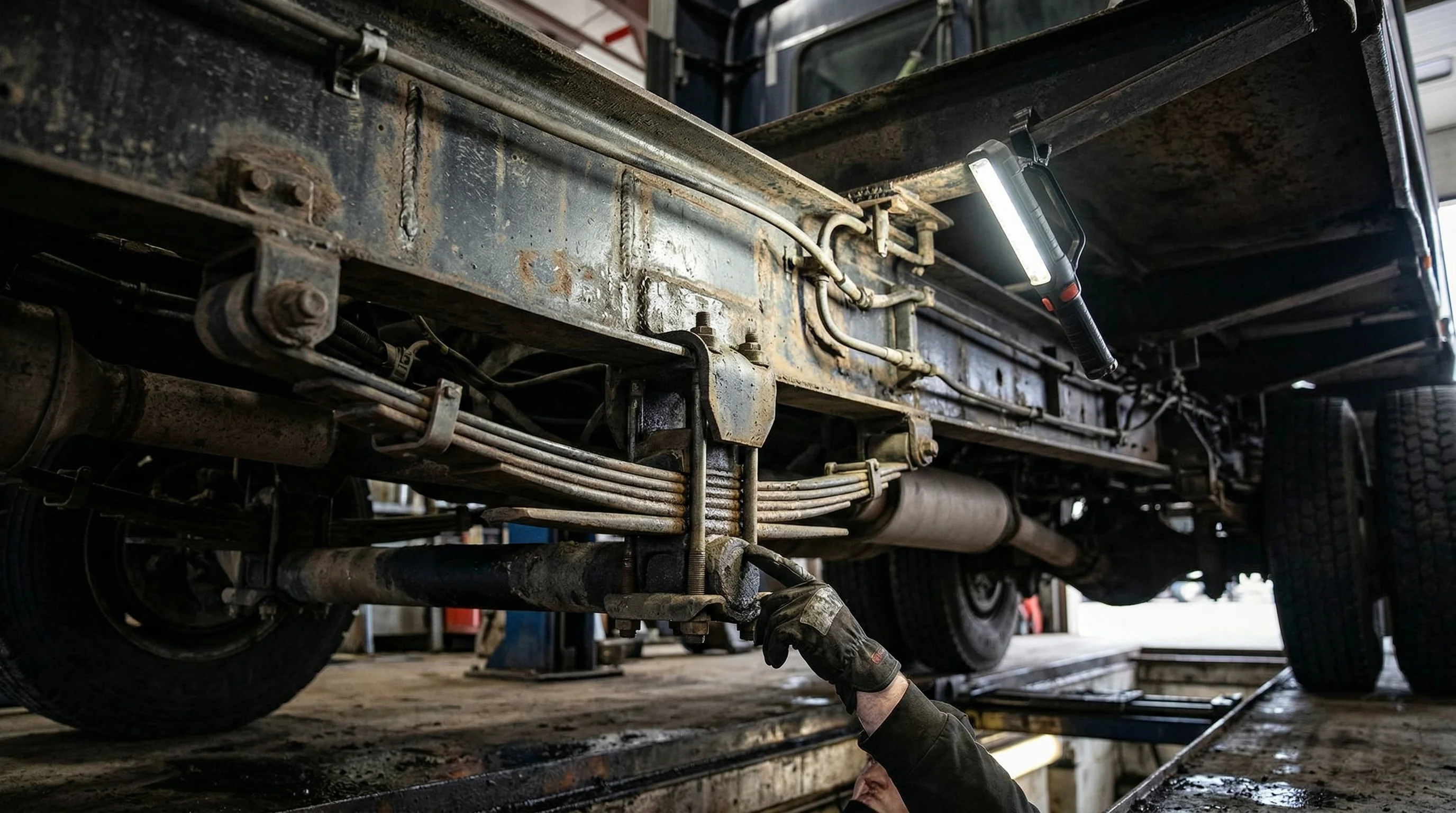
- Leaf springs — cracked, broken, or missing leaves
- Air bag suspension — leaks, mounting, proper inflation
- Shock absorbers — leaking fluid, loose mounting
- U-bolts and spring hangers — cracked, loose, or missing
- Axle alignment and positioning
5. Lighting and Electrical
- All headlights (high and low beam)
- Turn signals — front, rear, and side
- Brake lights and tail lights
- Marker lights and clearance lights
- Licence plate light
- Reflectors and retroreflective tape
- Wiring condition — no exposed, frayed, or improperly spliced wires
- Horn operation
6. Exhaust System
- Full inspection from engine to tailpipe
- Leaks at any point in the system (carbon monoxide risk = major defect)
- Secure mounting — no loose hangers or brackets
- Proximity to wiring, fuel lines, or other heat-sensitive components
- Catalytic converter and DPF condition (where equipped)
7. Frame and Body
- Frame rails — cracks, corrosion, or holes
- Cross-members — structural integrity
- Cab mounts — loose or cracked
- Body panels — secure mounting, no sharp edges that could injure
- Floor condition — rust-through that could allow exhaust entry
8. Coupling Devices
- Fifth wheel — mounting, locking mechanism, wear on pivot
- Pintle hooks — proper latching, wear, mounting bolts
- Safety chains/cables — condition and proper attachment
- King pin — wear measurement, cracks
- Drawbar eyes and connections
9. Fuel System
- Tank mounting — straps, brackets, condition
- Fuel cap seal
- Fuel lines and fittings — leaks, chafing, routing
- No leaks anywhere in the system
10. Windshield and Glass
- Cracks or chips in the driver’s direct line of sight
- Wiper blades — condition and operation
- Washer fluid system — functional reservoir and nozzles
- Defroster operation
11. Emergency Equipment
- Fire extinguisher — proper rating, charged, accessible, inspection tag current
- Reflective warning triangles — three required, in good condition
- Proper mounting and accessibility
12. General Items
- All mirrors — condition, mounting, adjustment
- Horn — audible at required distance
- Speedometer — operational
- Seat belts — condition and operation
- Mud flaps/splash guards where required
The 5 Most Common Reasons Trucks Fail Annual Inspection
During the 2025 CVSA International Roadcheck, 18.1% of all inspected vehicles were placed out of service — meaning they couldn’t move until repairs were made (CVSA, 2025). Nearly one in five. Here’s what’s catching them.
1. Brake Defects (40%+ of All OOS Violations)
Brake systems dominate the failure list every single year. The 2025 data showed brake-related issues — including the “20% defective brakes” category — made up more than 40% of all out-of-service violations (CVSA, 2025). Common problems: worn pads below minimum thickness, out-of-adjustment slack adjusters, air leaks in brake chambers, and cracked brake drums.
2. Tire Issues (21.4% of All OOS Violations)
Tires are the second biggest category. Bald tread, sidewall damage, under-inflation, and mismatched sizes on the same axle all trigger out-of-service orders. In British Columbia’s Lower Mainland alone, 56% of inspected commercial trucks were placed out of service during a 2025 enforcement blitz (CBC News, 2025).
3. Lighting Defects
Burned-out marker lights, broken reflectors, and corroded wiring connections are easy fixes that operators overlook constantly. A walk-around with every light turned on takes five minutes. Skipping it can mean a failed inspection.
4. Steering and Suspension Wear
Loose tie rod ends, worn ball joints, cracked leaf springs, and leaking air bags. These develop gradually and feel normal to the driver until the inspector measures actual play and finds it exceeds the standard.
5. Frame and Structural Issues
Ontario winters destroy frames. Salt corrosion eats through cross-members and rail flanges. Cracked welds at stress points develop over time. By the time you see visible rust-through, the structural integrity is already compromised.
From our shop: The inspection that surprises operators most is the brake check. A truck comes in and the driver says “brakes feel fine.” We pull the wheels and find the drums are scored, the linings are at 2 mm, and one slack adjuster hasn’t moved in months. Surface-level checks miss what’s happening inside. That’s exactly why Ontario requires a licensed technician with the equipment to look.
Top Out-of-Service Violation Categories — 2025 CVSA Roadcheck Top Out-of-Service Violation Categories — 2025 CVSA Roadcheck Brake Systems Tires/Wheels Lighting Steering/Suspension Frame/Body 40%+ 21.4% 12.8% 9.2% 6.4% Source: CVSA International Roadcheck Results, 2025 Brake percentage includes combined brake system + 20% defective brakes categories Source: CVSA International Roadcheck Results, 2025. Brake violations alone outweigh all other categories combined.
What Happens When Your Truck Fails Inspection?
Fines for operating a commercial vehicle without a valid annual inspection sticker range from $400 to $20,000 under Ontario’s Highway Traffic Act, with the possibility of up to 30 days imprisonment (Ontario Courts Schedule 43, 2026). And that’s just the legal penalty. The real cost is everything that piles up behind it.
When your truck fails an annual inspection, the inspector records every defect found. Major defects mean the vehicle cannot be operated — period. It stays parked at the shop or gets towed back to your yard. You don’t get an inspection sticker until every major defect is repaired and the vehicle passes re-inspection.
Here’s what that looks like in practice:
- Repair costs — Whatever it takes to fix the defects. Brakes, tires, suspension components — these aren’t cheap on commercial trucks
- Re-inspection fees — You’ll pay again for the inspector’s time on the second visit
- Downtime — Unplanned vehicle downtime costs $448 to $760 per day in lost productivity (OxMaint, 2025). If parts need ordering, that’s days, not hours
- CVOR impact — Every failed inspection feeds data into your CVOR record. A pattern of failures drags your safety rating down, which hits insurance rates and can trigger an MTO facility audit. Learn more about how CVOR ratings work and why they matter
- Insurance — Insurers check CVOR records at renewal. A poor record means higher premiums — sometimes 30-40% higher
The math is simple. Fix problems before the inspection, or pay more to fix them after — plus fines, plus downtime, plus the CVOR hit.
How to Prepare Your Truck for an Annual Safety Inspection
Reactive repairs cost three to nine times more than planned maintenance (Platform Science, 2025). A pre-inspection check at your own yard won’t catch everything — you don’t have the equipment to measure brake drums or test air systems under load — but it’ll catch the obvious failures that waste everyone’s time.
Here’s the preparation checklist we recommend to every operator who books with us:
Before You Book
- Check your brakes — Listen for air leaks with the system pressurized. Check visible pad thickness where you can see it. If you hear hissing or see pads below 3 mm, you already know there’s work to do
- Inspect every tire — Measure tread depth (minimum 2/32″ for steer tires). Look for sidewall cuts, bulges, or exposed cords. Check inflation with a gauge, not a kick. Look at the rims for cracks
- Walk around with all lights on — Every single one. Headlights high and low, signals, brake lights, markers, clearance lights, licence plate light, reflectors. Have someone press the brake pedal while you watch. This five-minute check catches the most common easy-to-fix failure
- Check steering play — With the engine running and wheels on the ground, rock the steering wheel. You shouldn’t see more than about 2 inches of free play before the wheels start to move
- Look at your suspension — Walk under the truck and look for cracked leaf springs, leaking shocks, loose U-bolts, or air bags that are deflated or leaning
- Examine the frame — Look at the frame rails and cross-members. Especially around the cab mounts, spring hangers, and any welded joints. Ontario salt does damage that builds up quietly over winters
- Test emergency equipment — Is your fire extinguisher charged? Check the gauge. Are your three reflective triangles present and in usable condition?
- Gather your documents — Registration, insurance, CVOR certificate, and previous inspection records
The hidden brake problem: Many operators skip the brake pre-check because the pads they can see look fine. But the inside of the drum tells a different story. Scoring, heat cracks, and out-of-round drums don’t show until the wheel comes off. And slack adjusters can look fine visually while being seized — they haven’t moved in months, but nobody noticed because the brakes still “worked.” The annual inspection catches what a visual check can’t.
The 2026 CVSA International Roadcheck is scheduled for May 12–14 and will focus on hours-of-service compliance and tire maintenance (CVSA, 2026). If your annual inspection falls near that window, it’s worth booking early to avoid the rush.
Annual vs. Semi-Annual vs. Daily Inspections — What’s the Difference?
Ontario has three distinct inspection tiers for commercial vehicles, and each serves a different purpose (Ontario.ca). Confusing them is a common mistake. Here’s how they break down.
| Feature | Daily (Schedule 1) | Annual (NSC 11B) | Semi-Annual |
|---|---|---|---|
| Who performs it | Driver | Licensed MVIS technician | Licensed MVIS technician |
| Frequency | Every 24 hours | Every 12 months | Every 6 months |
| Scope | Walk-around + cab check | Full mechanical inspection, wheels-off | Full mechanical + under-vehicle |
| Documentation | Trip inspection report | Inspection certificate + sticker | Inspection certificate + sticker |
| Which vehicles | All commercial vehicles | All >4,500 kg GVWR | School buses, accessible vehicles |
| What it catches | Obvious defects, leaks, lights | Hidden mechanical issues, wear measurements | Same as annual, twice as often |
Your daily trip inspection doesn’t replace the annual. Think of it as a safety net between thorough inspections. The daily catches obvious issues — fluid leaks, flat tires, burned-out lights. The annual catches the problems that need tools, measurement equipment, and a licensed technician to find.
For a full overview of all Ontario commercial vehicle requirements — CVOR, inspections, DriveON, ELDs, and more — see our Ontario commercial vehicle compliance guide.
Frequently Asked Questions
How much does an annual truck inspection cost in Ontario?
Inspection costs in Ontario aren’t government-regulated and vary by shop and vehicle type. A passenger vehicle safety inspection might run $150 to $300, but a commercial truck annual inspection is a different job entirely. A Class 8 truck typically requires 6 to 8 hours of shop time at labour rates of $120 to $200 per hour, putting the total in the $700 to $1,000+ range. The time depends on vehicle condition — pulling wheels and drums to inspect brakes adds hours. But the real cost isn’t the inspection — it’s failing one. Re-inspection fees, repair bills, and unplanned downtime at $448 to $760 per day add up fast.
How long does an annual safety inspection take?
A thorough annual inspection on a well-maintained truck takes 6 to 8 hours if the inspector finds major issues, you can expect it to take even longer. Tractor-trailer combinations take longer than single unit trucks because the trailer gets its own inspection. Inspection times can very greatly depending on vehicle type and condition.
Can I do my own annual inspection?
No. Ontario requires all annual and semi-annual inspections to be performed by a licensed Motor Vehicle Inspection Technician at a licensed inspection station (Ontario.ca). This isn’t optional. The technician must hold the appropriate licence class for the vehicle type being inspected.
What’s the difference between a safety standards certificate and an annual inspection?
A safety standards certificate (SSC) is required when you sell or transfer a vehicle — it confirms the vehicle meets basic safety standards at that moment. An annual inspection is a recurring compliance requirement for commercial vehicles over 4,500 kg. Different standards, different purpose. You can have a valid SSC and still need an annual inspection, and vice versa.
Does my trailer need its own annual inspection?
Yes. Every trailer over 4,500 kg GVWR requires its own separate annual inspection, independent of the truck pulling it. The trailer receives its own inspection certificate and sticker. If you run three trailers behind one truck, that’s three separate annual inspections — one for each trailer, plus one for the truck. Fleets average 8.7 days of unplanned downtime per vehicle per year (OxMaint, 2025), so scheduling trailer inspections strategically can prevent compounding downtime.
Don’t Wait for the Inspector to Find the Problem
Annual inspections aren’t paperwork — they’re the line between a safe truck and an out-of-service order. Here’s what matters most:
- Brakes are the #1 fail point. Over 40% of all out-of-service violations are brake-related. Don’t assume they’re fine because the pedal still works
- Tires are #2. A five-minute tread depth check prevents 21.4% of the most common OOS violations
- The easy stuff gets overlooked. Lights, reflectors, emergency equipment — the simplest checks catch the simplest failures
- Failed inspections compound. It’s not just the repair bill. It’s the downtime, the CVOR hit, the insurance increase, and the re-inspection fee
- Pre-inspection checks save money. Reactive repairs cost 3–9x more than catching problems before your appointment
From our shop: After 35 years of performing annual inspections, the single best thing we’ve seen operators do is a 30-minute self-check one week before their inspection appointment. Not the day before — a week before. That gives you time to order parts and schedule repairs before the clock starts ticking at the inspection station.
London Custom Truck & Car Repair is a licensed Motor Vehicle Inspection Station in London, Ontario. We perform annual and semi-annual safety inspections for commercial trucks, trailers, and fleet vehicles. If you need to book an inspection or want to know what shape your truck is in before your appointment, give us a call or stop by the shop.