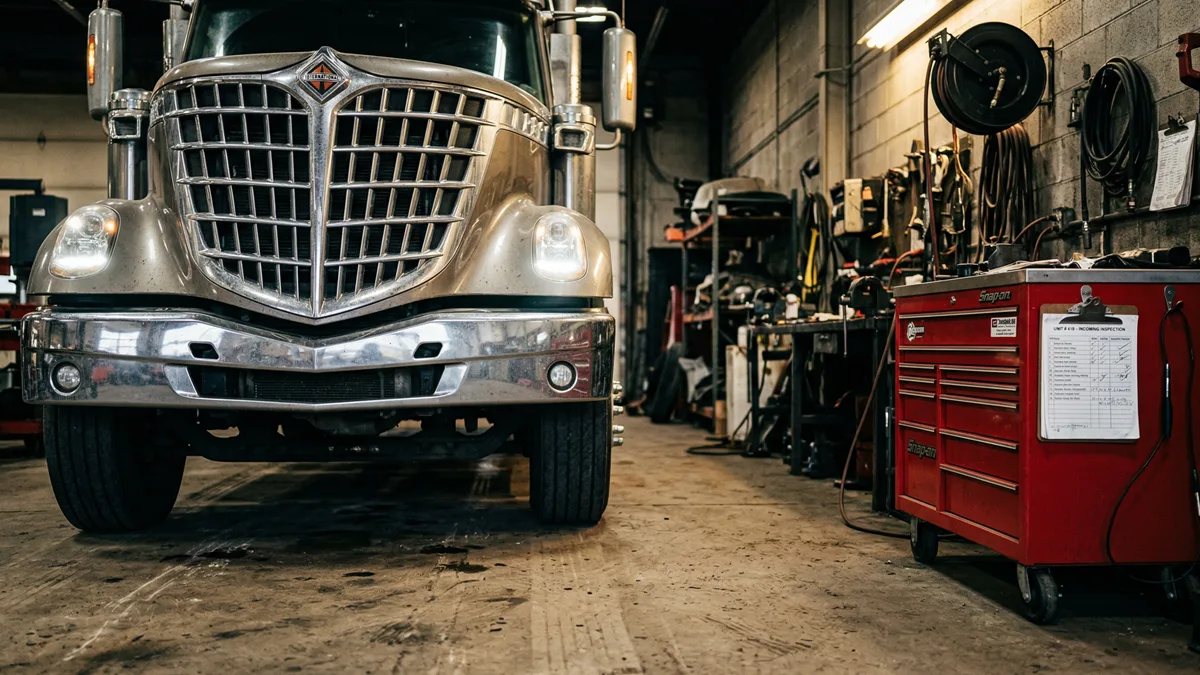
Ontario commercial vehicle compliance can cost you up to $50,000 in fines for a single wheel separation. That’s not a typo, and it’s just one of dozens of requirements for commercial vehicles in this province.
Whether you run a fleet of Class 8 highway tractors or a pickup truck that tows a loaded trailer on weekends, Ontario’s Highway Traffic Act has rules that apply to you. The problem? Those rules are scattered across multiple government pages, regulations, and programs. CVOR, DriveON, HOS, NSC — it’s alphabet soup, and the penalties for getting it wrong are steep.
This Ontario commercial vehicle compliance guide pulls everything together into one reference. You’ll find what vehicles are covered, what inspections you need, what the new DriveON program changed, and exactly what happens when you don’t comply. It’s based on current Ontario regulations and over 35 years of performing these inspections at our shop in London, Ontario.
Key Takeaways
- Ontario classifies vehicles as commercial at 4,500 kg combined gross weight. Many pickup-and-trailer combos qualify without the owner realizing it
- CVOR registration costs $250 and is mandatory for all qualifying commercial operators (Ontario.ca)
- The DriveON digital inspection program replaced paper-based MVIS on April 1, 2025
- Non-compliance penalties range from $310 (missing CVOR display) to $50,000 (wheel separation), plus minimum 15-day vehicle impoundment for critical defects
- Routine annual maintenance costs $5,000-$8,000/year per truck, far less than a single enforcement penalty
What Counts as a Commercial Vehicle in Ontario?
Ontario defines a commercial motor vehicle as any vehicle with a gross weight exceeding 4,500 kg (9,920 lbs), any bus seating 10 or more passengers, all tow trucks regardless of weight, and concrete pumps or mobile cranes used on highways (Ontario.ca). That 4,500 kg threshold catches more people than you’d think.
Here’s the part that trips people up. Ontario uses whichever number is highest: your total gross weight, registered gross weight, or the manufacturer’s gross vehicle weight rating (GVWR). You don’t get to pick the most favorable one. If any single measure crosses 4,500 kg, you’re in.
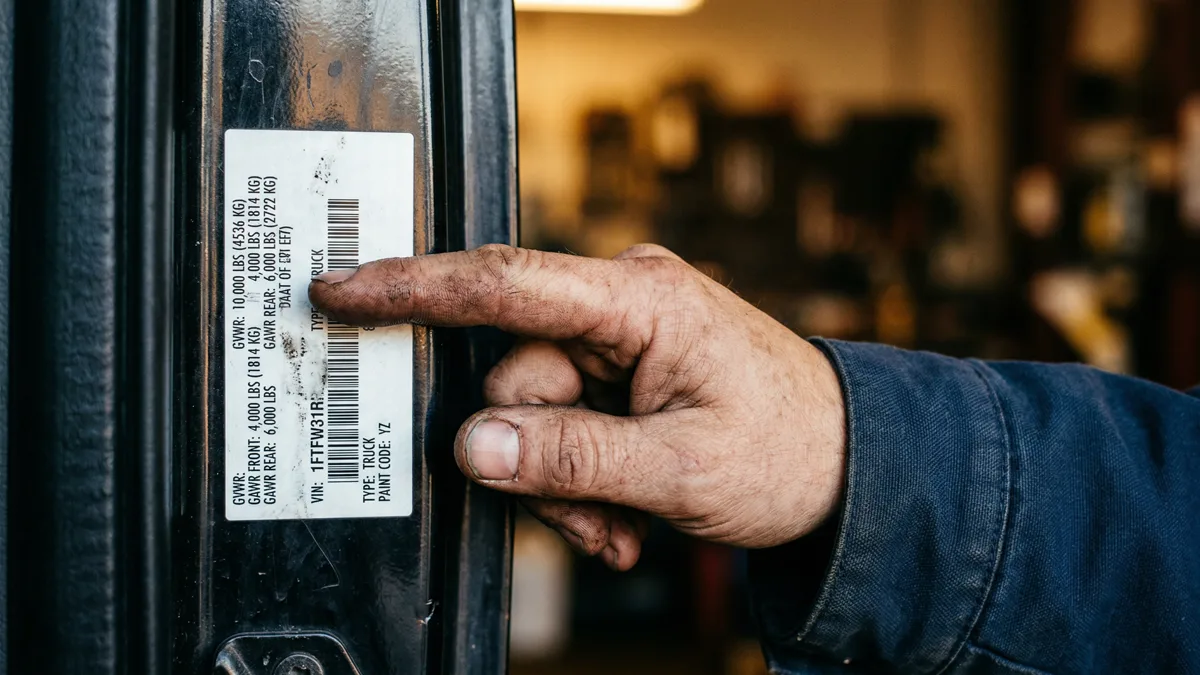
There’s a quick way to check. Find the GVWR sticker on your truck’s door jamb. Find the one on your trailer. Add them together. If the total hits 4,500 kg or more, Ontario considers that combination a commercial vehicle.
We see this surprise people constantly at our shop. Landscapers with a 3/4-ton pickup and a loaded utility trailer. Contractors hauling materials on a flatbed. Horse owners with a heavy stock trailer. None of them thought they were running a “commercial vehicle” until a roadside inspection said otherwise.
Quick Reference: Is Your Vehicle Commercial?
| Vehicle Combination | Typical Combined GVWR | Commercial? | What’s Required |
|---|---|---|---|
| Half-ton pickup + light utility trailer | ~3,800 kg | Usually no | Standard rules |
| 3/4-ton pickup + loaded equipment trailer | ~5,400 kg | Yes | CVOR, annual inspection, daily checks |
| F-350/Ram 3500 + horse trailer | ~5,800 kg | Yes | CVOR, annual inspection, daily checks |
| Class 6 straight truck (single unit) | ~11,000 kg | Yes | Full compliance + ELD |
| Class 8 tractor-trailer | ~36,000 kg | Yes | Full compliance + ELD + speed limiter |
| Pickup truck (personal use, unmodified box) | ~3,500 kg | No | Exempt if personal and GVWR under 6,500 kg |
The personal-use exemption is narrow. Your pickup must have a GVWR of 6,500 kg or less, carry the original unmodified manufacturer’s box, haul no commercial cargo, and receive no compensation for its use. Miss any one of those conditions and you’re back in commercial territory.
85% of Canadian trucking companies operate fewer than 20 trucks (World Metrics, 2026). Many are owner-operators or small businesses that may not realize the full scope of what Ontario requires. The rest of this guide breaks it all down.
What Is a CVOR and Who Needs One?
A Commercial Vehicle Operator’s Registration (CVOR) is mandatory for any Ontario operator running vehicles over 4,500 kg, buses carrying 10+ passengers, or vehicles transporting dangerous goods. It costs $250 to obtain and functions as your safety record card with the Ministry of Transportation (Ontario.ca).
Think of your CVOR like a credit score for your fleet’s safety. The MTO tracks everything tied to your CVOR number: collisions, driver convictions, facility audit results, and roadside inspection outcomes. Every infraction stays on your record for a minimum of two years. Pile up enough negative marks and the MTO will audit your operation, jack up your insurance premiums, or restrict your ability to operate entirely.
Your CVOR number must be displayed on every qualifying vehicle in your fleet. This isn’t optional. Failing to display it is one of the most common violations at roadside inspections. Improper CVOR display was cited in 28% of commercial vehicle inspections resulting in violations, making it a top-5 compliance issue (Traffic Paralegal Services, 2024). The fine starts at $310 per vehicle.
Here’s what a poor CVOR rating actually costs you in practice. It’s not just the fines. Your insurance carrier reviews your CVOR record at renewal. A string of violations can push premiums up by thousands. Some insurers will drop you altogether. And if the MTO initiates a facility audit based on your rating, you’re looking at staff time, paperwork, and potential operating restrictions while you bring everything up to standard.
We’ve worked with fleet operators in London who didn’t realize their CVOR was accumulating points from minor driver infractions. By the time they noticed, their insurance renewal came in 40% higher than the previous year. Monitoring your CVOR proactively, even once a quarter, can prevent that kind of surprise.
For the full breakdown on who needs a CVOR, how to apply, and how to manage your safety rating, see our detailed guide: What Is a CVOR and Does Your Truck Need One?
What Inspections Does Ontario Require?
Ontario mandates three levels of inspection for commercial vehicles: annual safety inspections every 12 months, semi-annual inspections every 6 months for passenger vehicles, and daily pre-trip inspections within 24 hours of driving (Ontario.ca). Each serves a different purpose, and missing any of them puts your CVOR at risk.
Inspection Types at a Glance
| Inspection Type | Frequency | Applies To | Performed By | Validity |
|---|---|---|---|---|
| Annual safety | Every 12 months | Trucks, trailers, converter dollies >4,500 kg; all tow trucks; concrete pumps | Licensed DriveON VIC technician | 12 months (yellow sticker) |
| Semi-annual | Every 6 months | Buses with 10+ passengers; school vehicles with 6+ passengers; accessible vehicles | Licensed DriveON VIC technician | 6 months |
| Daily pre-trip | Every 24 hours before driving | All commercial vehicles | Driver | 24 hours |
| Safety Standards Certificate (SSC) | As needed | Ownership transfer, rebuilt vehicles, status change | Licensed DriveON VIC technician | 36 days |
What Happens During an Annual Inspection?
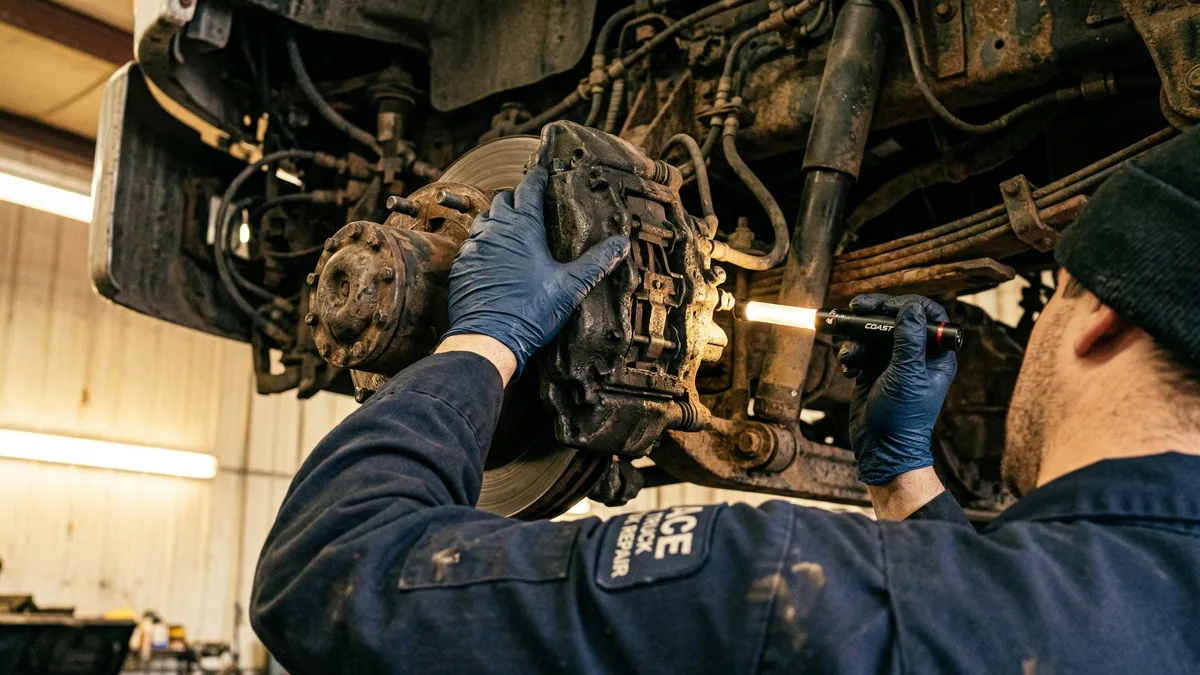
At our shop, a typical annual inspection on a Class 8 truck takes 6 to 8 hours. Our technicians work through over 100 individual checkpoints across 10 categories: powertrain, suspension, brakes (both hydraulic and air systems), steering, instruments and gauges, lamps and reflectors, electrical system, body and frame, tires and wheels, and coupling devices.
The most common fail points we see — after 35 years of performing these inspections — are brake adjustment out of specification, corroded or leaking air lines, and lighting defects. Brake issues alone account for a significant portion of failures, which makes sense when you consider that Ontario holds operators to absolute liability for wheel separations. That means if a wheel comes off your truck, you’re liable regardless of whether you knew about the problem. Fines for wheel separation run from $2,000 to $50,000.
A useful detail many operators don’t know: under the DriveON program, a completed annual or semi-annual inspection can serve as a Safety Standards Certificate for 36 days after the inspection date. So if you’re selling or transferring a commercial vehicle, timing your annual inspection right can save you a separate SSC appointment.
Daily Pre-Trip Inspections
Every commercial vehicle must have a written daily inspection completed within 24 hours of being driven. The driver walks around the vehicle and checks brakes, tires, lights, steering, coupling devices, and load securement. The result gets recorded in writing.
Here’s how the defect system works:
- No defect found: Report is valid for 24 hours. Drive on.
- Minor defect found: Must be recorded and reported to the operator. Repair is required, but the vehicle can still operate for 24 hours.
- Major defect found: The vehicle cannot be operated. Period. It stays parked until the defect is repaired.
Skipping daily inspections might seem harmless when nothing ever seems wrong. But when a roadside officer asks for your inspection report and you don’t have one, that’s a CVOR point and a fine you could’ve avoided with 10 minutes of work.
For a detailed walkthrough of what inspectors check at each station, see our guide: Annual Safety Inspection Checklist: What Inspectors Actually Look For (publishing soon).
What Is the DriveON Program and What Changed?
Ontario’s DriveON digital inspection program replaced the decades-old paper-based Motor Vehicle Inspection Station (MVIS) system on April 1, 2025 (Ontario.ca). If you’ve had an inspection done in the past year, you’ve already used it, even if you didn’t notice much difference from the driver’s seat.
The biggest change is behind the scenes. Inspection records are now fully digital. When your vehicle passes at a licensed DriveON Vehicle Inspection Centre (VIC), the results go into a centralized digital system instead of a paper form stuffed in a glovebox. For fleet managers, this is genuinely useful. You can track inspection status across your fleet without chasing down paper certificates.
DriveON also consolidated what used to be separate programs. The old MVIS handled safety inspections. The old Drive Clean program handled emissions. DriveON combines both under one umbrella. For heavy-duty diesel vehicles over 4,500 kg that are seven or more model years old, emissions testing via on-board diagnostics (OBD) is now part of the same process.
What didn’t change: you still need a licensed technician at a certified VIC to perform the inspection. You still get a yellow sticker for annual inspections. The inspection standards themselves (what gets checked and what constitutes a pass or fail) remain the same. DriveON changed the record-keeping system, not the mechanical standards.
Now that the program has been running for a year, a few practical observations from our experience as a licensed inspection facility in London, ON:
- Digital records mean fewer disputes about inspection validity at roadside checks. Officers can verify your status electronically.
- Scheduling is easier for fleet operators. You can confirm your vehicles’ inspection expiry dates without digging through paperwork.
- The transition was smoother than many operators expected. If you’ve been avoiding inspections because you weren’t sure how the “new system” works, it’s the same process you’re used to, just with a digital paper trail.
For a complete walkthrough of DriveON and what it means for your fleet’s workflow, see: What the DriveON Emissions Program Means for Your Fleet (publishing soon).
What Are Ontario’s Hours of Service Requirements?
Ontario commercial truck drivers face strict daily limits: a maximum of 13 hours driving, at least 10 hours off-duty, and they cannot drive after accumulating 14 hours of on-duty time (Ontario.ca). Electronic logging devices (ELDs) have been mandatory for truck drivers since June 12, 2022, and for bus drivers since July 1, 2023.
Here’s the full daily breakdown:
- Maximum driving time: 13 hours after a minimum 8-hour off-duty period
- Maximum on-duty time: 14 hours (includes driving + non-driving work)
- Maximum elapsed time: 16 hours from the start of your on-duty period
- Minimum off-duty: 10 hours in a day
On top of daily limits, Ontario enforces cycle limits. You can choose between two options:
- Cycle 1: Maximum 70 hours on-duty in any 7 consecutive days
- Cycle 2: Maximum 120 hours on-duty in any 14 consecutive days
There’s one exemption worth knowing: if you operate within 160 km of your home terminal, you aren’t required to maintain hours of service logs. That covers a lot of local operators in and around London, Ontario. But if your routes take you to Kitchener, Sarnia, or beyond, you’re outside that radius and the logging requirements kick in.
As of early 2026, commercial drivers must submit digital logs quarterly, integrating with national sharing systems for cross-border hauls. If you’re running loads into the U.S. or other provinces, your ELD records travel with you.
For the complete hours of service rulebook, including sleeper berth provisions and reset rules, see: Hours of Service Rules for Ontario Truck Operators (publishing soon).
What Are the Penalties for Non-Compliance?
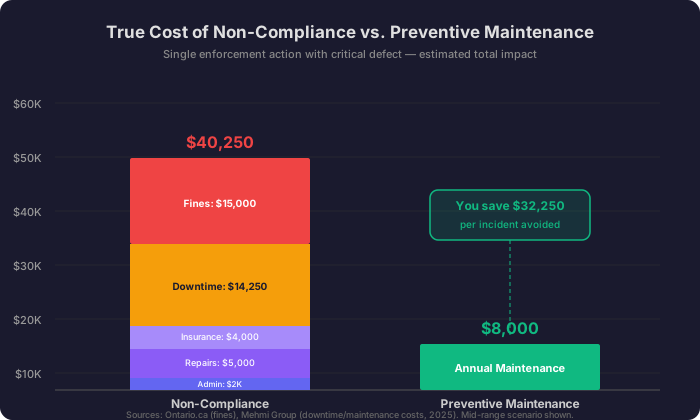
Non-compliance penalties in Ontario start at $310 for a missing CVOR number display and climb to $50,000 for wheel separation — and that’s before you count the real cost: truck downtime that runs $700 to $1,200 per day in lost revenue (Mehmi Group, 2025).
Penalty Reference Table
| Violation | Fine Range | Additional Consequences |
|---|---|---|
| CVOR number not displayed | $310+ per vehicle | CVOR points |
| Wheel separation | $2,000 – $50,000 | Absolute liability (applies regardless of fault) |
| General unsafe vehicle condition | Up to $20,000 | Vehicle prohibited from highway until repaired |
| Critical mechanical defect | Impoundment | Minimum 15-day impound; plates and stickers removed |
| Operating without valid inspection | Varies | Out-of-service order, CVOR demerit points |
| Missing daily inspection report | Varies | CVOR demerit points, fine |
| Hours of service violation | Varies | Driver out-of-service, CVOR points |
The penalties above are just the direct fines. The full financial picture is worse.
The True Cost of a Single Enforcement Action
Consider what happens when a roadside inspection uncovers multiple defects — which is common, because problems tend to cluster on neglected vehicles:
Direct costs:
- Fines for each violation (they stack, so three defects means three fines)
- Towing to a repair facility if the vehicle is placed out of service
- Repair costs to fix the defects
Indirect costs:
- Vehicle impoundment: minimum 15 days for critical defects. That truck earns zero revenue while it sits.
- Downtime: $700 to $1,200 per day in lost revenue, depending on the vehicle and route
- CVOR damage: every infraction stays on your record for 2+ years
- Insurance: your carrier reviews your CVOR at renewal. Violations mean higher premiums or dropped coverage
- Audit risk: enough CVOR points trigger an MTO facility audit, which consumes management time and may result in further operating restrictions
We’ve watched fleet operators in London get blindsided by a single bad inspection that cascaded into weeks of lost revenue. One truck gets impounded for 15 days. The driver is reassigned or idle. The CVOR takes a hit. Insurance goes up at renewal. The total cost of that one roadside stop can easily exceed $15,000 to $20,000 when you add it all up.
Compare that to the cost of staying ahead of it. Routine annual maintenance runs $5,000 to $8,000 per truck per year (Mehmi Group, 2025). A scheduled annual inspection at a licensed shop catches problems before enforcement does. The math isn’t close.
Speed Limiters, Load Securement, and Other Requirements
Ontario requires speed limiters set to a maximum of 105 km/h on commercial motor vehicles with a GVWR of 11,794 kg or more, built after December 31, 1994, that have an electronic control module (Ontario.ca). Ambulances and fire trucks are exempt. Everyone else stays at 105.
Beyond speed limiters, several other requirements apply to commercial operators:
Load securement: All cargo must comply with National Safety Code Standard 10. Tie-downs, chains, straps, and blocking must be rated for the load. Officers check this at roadside inspections, and improperly secured loads generate both fines and CVOR points.
Dangerous goods: If you haul any regulated product (fuel, chemicals, compressed gases), you need Transportation of Dangerous Goods (TDG) training and documentation. This applies even to seemingly small quantities.
Tow trucks (since January 1, 2023): Ontario added specific requirements for tow trucks including daily inspections regardless of weight, annual inspections regardless of weight, two warning lights, amber intermittent flash lamps when stopped on a highway, and high-visibility safety vests meeting CSA Standard Z96-15 for personnel working outside the vehicle.
Record-keeping: Operators must maintain driver qualification files (license, abstracts, training acknowledgements), vehicle maintenance records with preventive maintenance schedules, daily inspection reports, and HOS/ELD records. Incomplete records are a common finding during MTO audits.
Ontario Commercial Vehicle Compliance Checklist
Staying compliant isn’t complicated. It’s consistent. It comes down to three habits: maintain your inspection schedule, keep your records current, and work with an inspection shop that catches problems before enforcement does.
Here’s the checklist we walk our fleet customers through at London Custom Truck & Car Repair:
Registration and Display:
- [ ] Confirm your CVOR is active and current
- [ ] Verify CVOR numbers are displayed on every qualifying vehicle
- [ ] Check that your CVOR record is clean (review it at least quarterly)
Inspections:
- [ ] Schedule annual inspections before your sticker expires (don’t wait until the last week; book 30 days early)
- [ ] Ensure daily pre-trip inspections are completed and documented every operating day
- [ ] Keep inspection records organized and accessible for roadside officers
Drivers:
- [ ] Maintain driver qualification files for every driver (license, abstracts, training)
- [ ] Verify ELD compliance for all drivers operating beyond 160 km from home terminal
- [ ] Review hours of service logs monthly for patterns that approach limits
Vehicles:
- [ ] Follow a preventive maintenance schedule. Routine maintenance costs $5,000-$8,000 per year per truck, but prevents repairs that can run $10,000-$25,000 (Mehmi Group, 2025)
- [ ] Check combined weight of all truck-and-trailer combos against the 4,500 kg threshold
- [ ] Keep maintenance records with dates, mileage, and work performed
New for 2025-2026:
- [ ] Confirm your inspection facility is a certified DriveON VIC
- [ ] Verify emissions testing compliance for heavy-duty diesel vehicles 7+ model years old
- [ ] Ensure quarterly digital log submissions are on schedule for cross-border operations
London Custom Truck & Car Repair is a licensed inspection facility serving London, Ontario and the surrounding Southwestern Ontario region. We perform annual safety inspections, heavy-duty emissions testing, and comprehensive fleet maintenance programs for operations of all sizes. If you’re not sure where your fleet stands, reach out and we’ll help you figure it out.
Frequently Asked Questions
How much does an annual truck inspection cost in Ontario?
Annual safety inspections costs can vary by vehicle type and condition. A full annual inspection on a Class 8 truck typically requires 6 to 8 hours of labour. Although, there is a wide range among different vehicles due to style and condition. A well maintenance vehicle or newer vehicle will go a lot faster, while an older vehicle or one in poor condition will add a lot of time. Contact London Custom Truck & Car Repair at (519) 452-3170 for current inspection pricing.
What happens if my truck fails an annual inspection?
The vehicle must be repaired before it can pass. Minor defects (a burned-out marker light, for instance) can often be fixed the same day and the vehicle re-inspected. Major defects like brake system issues or structural problems may require the vehicle to be taken out of service until repairs are completed. The vehicle cannot legally operate with a failed inspection until a licensed technician confirms the defects are corrected.
Does my pickup truck need a CVOR if I’m towing a trailer?
If the combined GVWR of your pickup and trailer hits 4,500 kg and you’re using the combination for business purposes, then yes, you need a CVOR, annual inspections, and daily pre-trip checks. The personal-use exemption only applies if all conditions are met: GVWR of 6,500 kg or less, original unmodified manufacturer’s box, no commercial cargo, and no compensation. Even a contractor carrying tools in the bed technically falls outside the exemption.
How is the DriveON program different from the old MVIS system?
DriveON replaced MVIS on April 1, 2025, shifting inspection records from paper to digital. The mechanical inspection standards themselves didn’t change. Technicians still check the same items. The difference is administrative: results go into a centralized digital system, emissions and safety inspections are combined under one program, and officers can verify your inspection status electronically at roadside. For drivers, the experience at the shop is essentially the same.
Can a failed CVOR record be improved?
Yes. Your CVOR record reflects the past two years of violations, inspections, and audit results. Improving it means reducing new infractions (clean inspections, no driver convictions, no collisions) while older negative entries age off your record. Proactive steps include regular preventive maintenance, driver training, and quarterly CVOR record reviews to dispute any errors. A consistent clean record over 12-24 months will measurably improve your safety rating.
Keep Your Fleet on the Right Side of Ontario Commercial Vehicle Compliance
Ontario’s commercial vehicle rules exist for one reason: safety on Highway 401 and every other road in the province. The requirements aren’t going away. In fact, with DriveON’s digital tracking and the expanded 4,500 kg enforcement for pickup-and-trailer combos, compliance is getting tighter, not looser.
The good news is that staying compliant isn’t expensive compared to the alternative. A few thousand dollars a year in routine maintenance and scheduled inspections protects you from fines that can reach $50,000, impoundment that takes your truck off the road for weeks, and CVOR damage that follows you for years.
What to do next:
- If you’re unsure whether your vehicles qualify as commercial, add up your GVWRs and check the table above
- If your annual inspection stickers are approaching expiry, book an appointment before the last minute
- If you haven’t reviewed your CVOR record recently, request a copy and check for surprises
London Custom Truck & Car Repair has been keeping Southwestern Ontario’s commercial vehicles compliant and road-ready for over 35 years. We’re a licensed DriveON Vehicle Inspection Centre performing annual inspections, emissions testing, brake repair, and full fleet maintenance at our shop in London, Ontario. Contact us to schedule your next inspection.
Related guides in this series :
What Is a CVOR and Does Your Truck Need One?
London Custom Truck & Car Repair is located in London, Ontario, serving fleet operators and vehicle owners across Southwestern Ontario including Woodstock, St. Thomas, Ingersoll, Sarnia, Chatham-Kent, Stratford, and the Kitchener-Waterloo-Cambridge region. We’ve been in business since 1989.