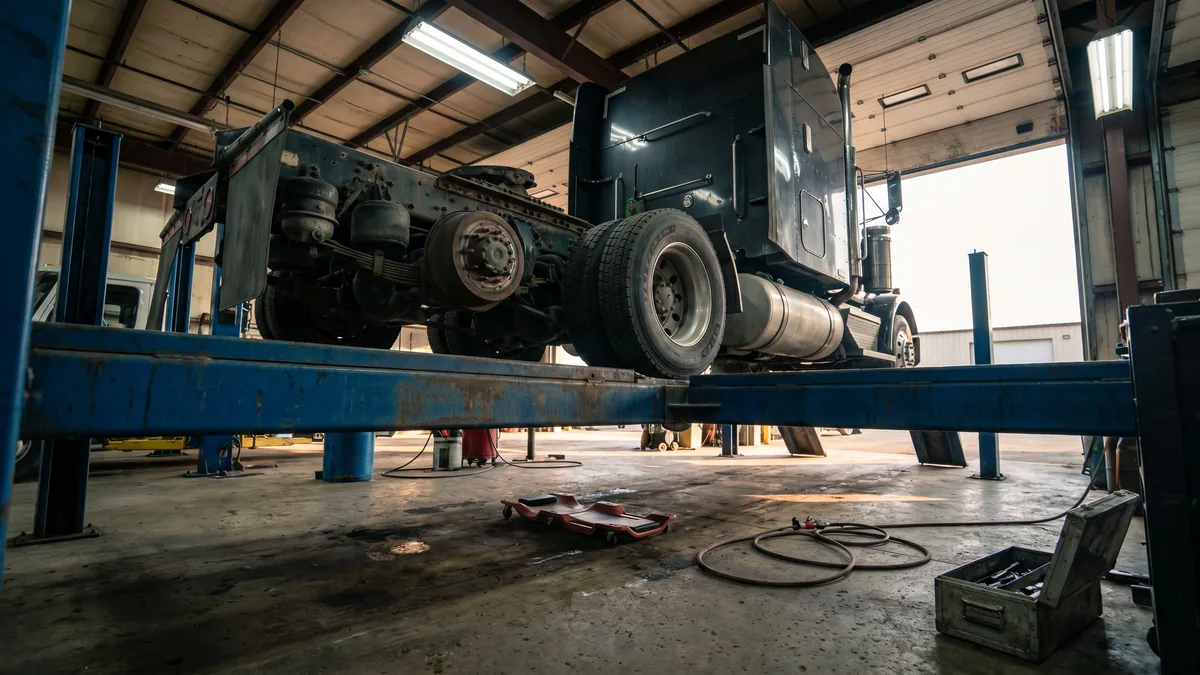
If you’ve ever wondered why trucks fail safety inspection in Ontario at the rate they do, the answer is simpler than most operators expect. A truck rolls into our shop on a Monday morning for a routine annual safety inspection. Three hours later we’re handing the operator a fail-and-fix sheet with seven defects on it. None of them are major. All of them are preventable. The truck spends two more days in the bay, costs the operator a chunk of revenue in downtime, and rolls out with a sticker that could have been issued on Monday afternoon if the right things had been checked the week before.
This scenario plays out every week. Not just at our shop, at every certified Vehicle Inspection Centre in Ontario. The same handful of defects causes most of the failures we see, and CVSA’s annual data backs it up: brake defects and tire issues alone account for nearly half of all out-of-service violations during roadside inspections (CVSA 2025 Roadcheck).
After 35 years of performing commercial vehicle inspections in London, Ontario, the pattern is consistent. The 10 fail points listed in this guide explain why trucks fail safety inspection in Ontario time after time. Each defect is detectable during routine maintenance. Each is dramatically cheaper to fix during a planned service than during a failed inspection.
Key Takeaways
- 18.1% of commercial vehicles inspected during the 2025 CVSA International Roadcheck were placed out-of-service for at least one critical defect (CVSA)
- Brake violations cause 24.4% of all vehicle out-of-service orders, the largest single category
- Tire violations are next at 21.4% of all vehicle OOS orders
- Approximately 4 million commercial vehicle inspections happen across North America every year (CVSA)
Last updated: April 23, 2026. This page is refreshed every 90 days or when new CVSA data is published.
How Ontario Inspection Failures Are Tracked
Annual safety inspections in Ontario follow National Safety Code Standard 11, Part B, the same standard used by every Canadian province. Roadside inspections by Ministry of Transportation officers and the Ontario Provincial Police follow the CVSA North American Standard, which feeds into the same data pool.
The CVSA International Roadcheck is the largest single source of public inspection statistics in North America. Each year, inspectors across Canada, the United States, and Mexico run a coordinated three-day blitz and publish results. The 2025 data set covered 56,178 inspections and produced 13,553 vehicle out-of-service violations, an 18.1% vehicle out-of-service rate. Brake systems alone accounted for 24.4% of those OOS violations, and brake adjustment defects added another 16.7%. Combined, brake-related issues drove more than 41% of every vehicle taken out of service. Tires were the next single category at 21.4% (CVSA).

The same fail patterns we see in our annual inspection bay match the CVSA roadside data almost exactly. That’s because the inspection criteria are nearly identical. A defect that fails an annual inspection is the same defect that earns an out-of-service order at the side of the road.
For the full breakdown of what happens during an annual inspection and what each category covers, see our annual safety inspection checklist.
1. Brake System Defects: The #1 Reason Trucks Fail Safety Inspection in Ontario
Brake defects are the single most common reason trucks fail safety inspection in Ontario, and the most common reason they’re placed out-of-service at roadside inspections. Brake-related issues accounted for 24.4% of all vehicle out-of-service violations during the 2025 CVSA International Roadcheck (CVSA).
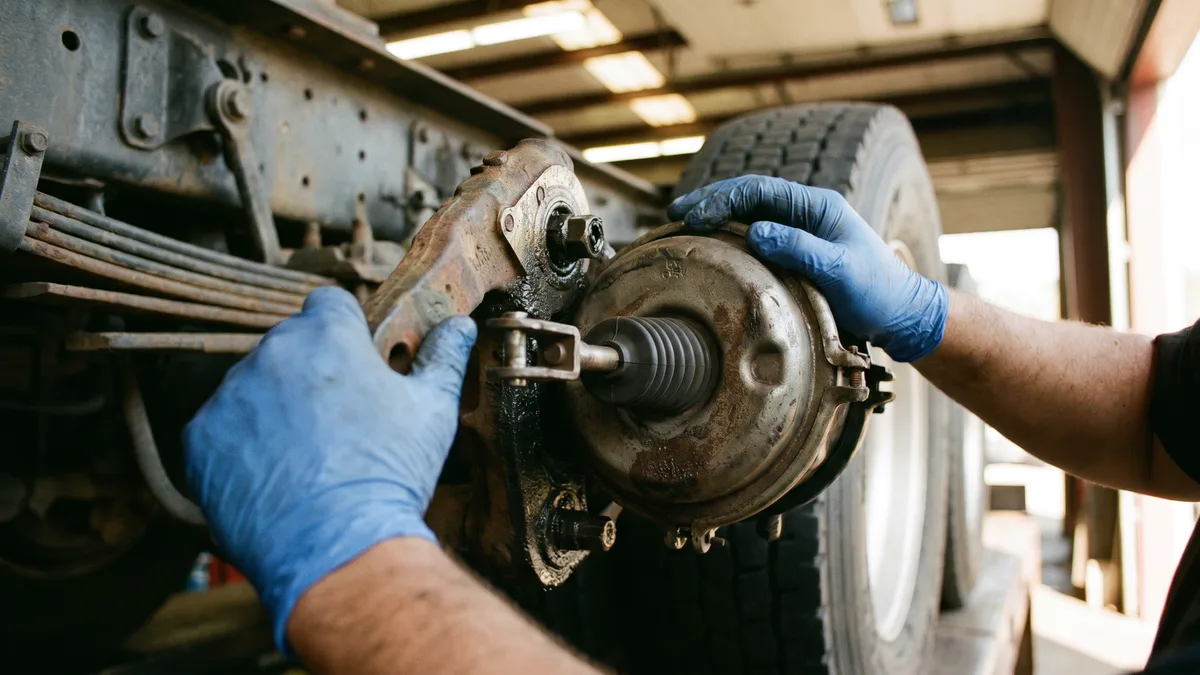
What inspectors check: Brake stroke at every wheel, lining thickness, slack adjuster condition, air-system leak rate, ABS warning lights, brake hose condition, drum thickness and cracking, foundation brake hardware.
Most common specific failures:
- Out-of-adjustment slack adjusters (stroke beyond limits)
- Worn linings (under 1/4 inch on most trucks)
- Cracked or oversized drums
- Air leaks at chambers and fittings
Why they accumulate: Air brakes self-adjust within tolerance, but worn slack adjusters and corroded mechanisms fail to compensate. Drivers often don’t feel the difference until braking is dangerously degraded. By that point the truck has been operating with marginal brakes for weeks.
2. Tire Defects
Tire violations are the second-largest category of out-of-service orders, responsible for 21.4% of all vehicle OOS violations in the 2025 CVSA Roadcheck (CVSA). Tire fails are also the most preventable. Every defect on the list shows up to a thorough walk-around.
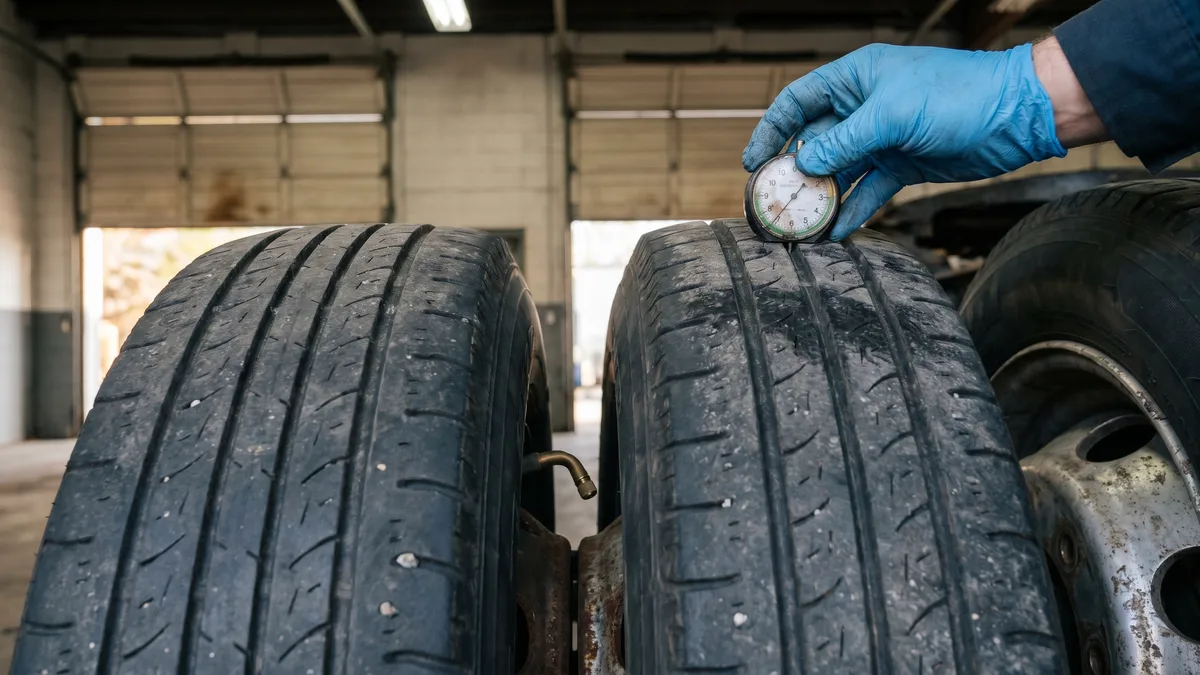
What inspectors check: Tread depth (minimum 4/32 on steer axles, 2/32 on drive and trailer axles), sidewall condition, exposed cord or belt, mismatched sizes on the same axle, flat or low tires, tire age cracks.
Most common specific failure: Inner duals worn under minimum tread depth. Drivers cannot see them from outside the truck without crouching, and most never check them between PM intervals.
Why they accumulate: Inner-dual wear is the silent killer. Without a thorough walk-around using a tread depth gauge, the inside tire on a dual wheel can be at 1/32 while the outside still looks fine.
From our shop: Keep a tread depth gauge in the cab. Take 60 seconds at every fuel stop to check the inner duals. That single habit prevents the second-most common annual inspection fail.
3. Lighting and Electrical Defects
Lighting defects are among the easiest fails to fix and the most embarrassing to receive. Every component on the list takes 10 minutes and a $5 bulb to repair.
What inspectors check: Headlights (low and high beam), tail lights, brake lights, turn signals, marker lights, clearance lights, license plate lights, reflectors, ABS warning indicator, instrument-panel warning lights.
Most common specific failures:
- Burned-out clearance and marker lights on trailer rear end-of-frame
- Cracked lens housings
- Loose ground connections causing intermittent operation
- ABS warning light illuminated (electrical fault in trailer ABS controller)
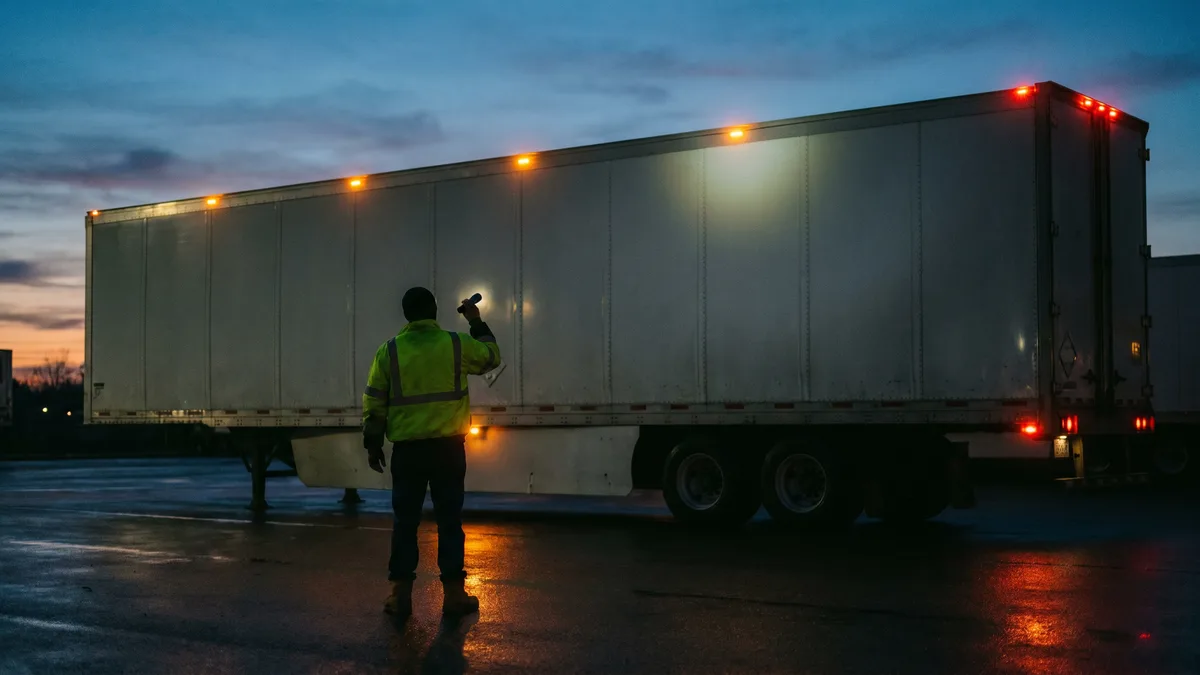
Why they accumulate: Drivers see what’s in front of them; they don’t routinely walk behind the trailer pre-trip. Marker lights at the back of a 53-foot trailer often go unnoticed for weeks.
The fix is trivial. The discipline isn’t. A monthly walk-around with a flashlight at dusk catches every lighting defect before it costs you a sticker.
4. Steering and Suspension Wear on High-Mileage Trucks
Steering and suspension fails happen most often on higher-mileage trucks, typically 500,000 km and up. The wear is gradual, invisible from above, and shows up only when an inspector pries components with a long bar.
What inspectors check: Tie rod ends, drag link play, kingpin slop, ball joints (where present), U-bolts, leaf spring eyes, leaf spring center bolts, shock absorber condition, air bag condition (on air-ride suspensions), torque rod bushings.
Most common specific failures:
- Worn kingpins (vertical or horizontal play beyond spec)
- Loose tie-rod ends causing steering wheel free play
- Broken or cracked leaf spring center bolts
- Torque rod bushing failure (creating axle misalignment)
Why they accumulate: Wear is gradual. A truck with marginally loose kingpins drives normally, until the inspector pries them and finds 1/8 inch of vertical play that’s been there for 100,000 km.
5. Exhaust System Defects
Exhaust fails are increasingly tied to emissions enforcement. Beyond the basic “no leaks” requirement, Ontario inspectors now check for tampering with diesel particulate filters (DPF), diesel exhaust fluid (DEF) systems, and exhaust gas recirculation (EGR) components.
What inspectors check: Cracks, holes, leaks anywhere in the exhaust system; flex joints; aftertreatment housing condition; DPF and DEF presence and operation; secure mounting hangers and clamps.
Most common specific failures:
- Cracked exhaust manifold or downpipe at flex joints
- Damaged DPF aftertreatment housing
- Tampered or removed DPF/DEF systems (automatic fail and potential plate seizure)
Connection to DriveON: Tampered or removed DPF systems will automatically fail the OBD portion of the DriveON emissions program test. Ontario actively enforces emissions tampering with fines and plate removal.
6. Frame and Body Corrosion: A Southwestern Ontario Specialty
Frame corrosion is the silent reason trucks fail safety inspection in Ontario, especially in the southwest. The Highway 401 salt corridor accelerates rust from inside the frame rails outward, and structural fails often require multiple bay days to repair.
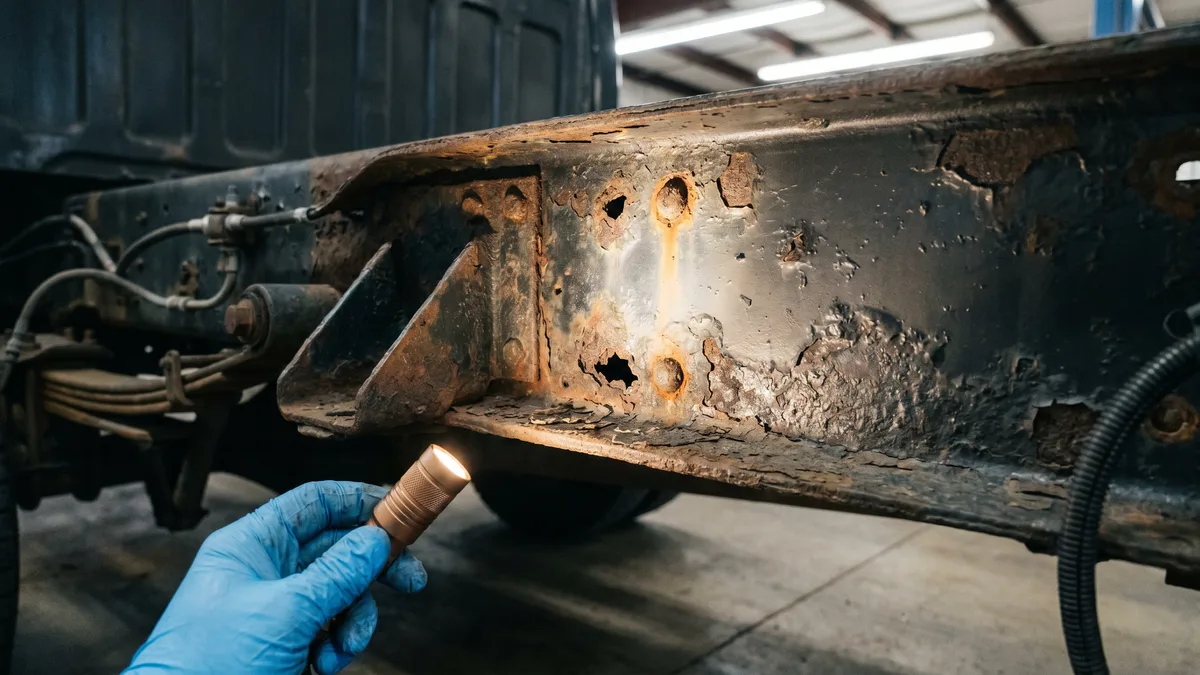
What inspectors check: Frame rails (especially near rear suspension hangers), cross-members, bumper mounts, body mounts, cab mounts, fuel tank straps, structural welds.
Most common specific failures:
- Frame rail rust-through near rear suspension hangers
- Cab mount corrosion
- Fuel tank strap failure from rust
Why it accumulates: Salt exposure on Highway 401 and surrounding routes. Rust starts inside the frame rail (where it’s not visible from the outside), works outward, and isn’t caught until inspection.
From our shop: Frame corrosion is the silent fail in Southwestern Ontario. We see it most on trucks that work the 401 corridor and don’t get washed regularly during the winter months. A monthly underbody wash from November through April adds years to a frame’s life.
7. Coupling Devices
Coupling devices fail more often than operators realize because the wear is physical, gradual, and out of sight unless someone deliberately measures it.
What inspectors check: Fifth-wheel jaw wear, lock condition, mounting bolts, pintle hook lock and chain, safety chains and hooks, glad-hand seals, electrical connector condition.
Most common specific failures:
- Worn fifth-wheel jaws (over 3/8″ wear at the kingpin contact face)
- Cracked or worn pintle hook
- Missing or damaged safety chain hooks
- Hardened or torn glad-hand seals
8. Fuel System Defects
Fuel system fails are usually inexpensive to fix but easy to miss during a casual walk-around because the leak is often slow and only visible when the truck has been parked for hours.
What inspectors check: Fuel tank straps, fuel cap, fuel lines, fittings, fuel filter housing, DEF tank and fittings, evidence of leaks anywhere in the system.
Most common specific failures:
- Cracked fuel cap (vapor leak fails sniff test)
- Leaking primary fuel filter housing seal
- Loose fuel tank straps allowing tank movement
- Cracked DEF tank from freeze damage
9. Windshield, Glass, and Mirrors
Glass fails are weather-driven. A small stone chip in November becomes a long crack by April after the windshield has cycled through a hundred freeze-thaw events.
What inspectors check: Windshield cracks (especially in the driver’s primary line of sight), mirror mounts, mirror condition, defroster operation, wipers, washer fluid system.
Most common specific failures:
- Stone-chipped windshield in driver’s primary line of sight (often grows over winter)
- Missing or broken mirror
- Broken wiper arm or torn wiper blade
- Non-functional washer fluid system
10. Emergency Equipment and General Items
This category is the easiest fail to prevent and the most frustrating to receive. Every item on the list is small, cheap, and entirely under the operator’s control.
What inspectors check: Fire extinguisher (charged, accessible, current expiry date), reflective triangles or flares (3 required), spare fuses (where applicable), seat belts (no cuts, full retraction, latching properly), first-aid kit (where required for passenger transport).
Most common specific failures:
- Expired fire extinguisher charge
- Missing reflective triangles
- Worn seat belt webbing or non-latching buckle
- No spare fuses
How to Prevent the Reasons Trucks Fail Safety Inspection in Ontario
Most of the 10 fail points above are detectable during routine preventive maintenance and dramatically cheaper to fix before inspection day. The same approach applies to every fleet, whether you’re an owner-operator or running a 50-truck operation.
Five-step pre-inspection plan:
- Schedule a pre-inspection PM 30 days before your annual inspection date. Use the time to fix anything that turns up. Don’t book the annual inspection until the PM is clean.
- Walk around the truck monthly with a flashlight. Check every light. Look at the inner duals. Check fluid levels and look for leaks. Five minutes a month catches most lighting and tire fails.
- Keep a tread depth gauge in the cab. Measure inner duals quarterly. Replace tires at 6/32, not at the legal minimum.
- Run a brake stroke check every 90 days (or after every 25,000 km). Out-of-adjustment brakes are the single most common fail and the easiest to catch.
- Build a relationship with a licensed inspection facility. Let the same shop see the truck for routine PM and the official annual. Continuity catches accumulating problems before they hit the fail threshold.
Frequently Asked Questions
Why do trucks fail safety inspection in Ontario most often?
Brake defects. Out-of-adjustment slack adjusters and worn linings cause the largest single category of failures. Brake systems accounted for 24.4% of all vehicle out-of-service violations during the 2025 CVSA Roadcheck, and brake adjustment defects added another 16.7%. Combined, brake-related issues drove more than 41% of every vehicle taken out of service (CVSA 2025 Roadcheck). The same pattern shows up in annual safety inspections at certified facilities. Brakes are the number one fail point, followed by tire defects.
What percentage of trucks fail roadside safety inspection?
Approximately 18.1% of commercial vehicles inspected during the 2025 CVSA International Roadcheck were placed out-of-service for one or more critical defects (CVSA). Annual inspection fail rates at certified facilities are similar. Roughly one in five trucks fails on first inspection without a recent pre-inspection PM.
What happens if my truck fails an annual safety inspection?
The inspection facility issues a fail report listing each defect. Your truck cannot return to commercial service until the defects are repaired and the truck is re-inspected. The annual inspection sticker isn’t issued until every fail point passes a complete re-inspection, and the vehicle remains out-of-service in the meantime.
How much does it cost to re-inspect a truck after a fail?
Related Resources
Explore these resources for deeper coverage of Ontario commercial vehicle compliance:
- Ontario Commercial Vehicle Compliance: Complete 2026 Guide. Pillar guide covering CVOR, annual inspections, DriveON, and every related compliance requirement
- Annual Safety Inspection Checklist: What Inspectors Actually Look For. Detailed walkthrough of the 100+ inspection checkpoints and what passes versus fails
- What Is a CVOR and Does Your Truck Need One?. How inspection results affect your CVOR safety rating
Book a Pre-Inspection Check Before Your Annual
The cheapest annual inspection is the one you don’t fail. London Custom Truck & Car Repair is a licensed DriveON Vehicle Inspection Centre in London, Ontario. We’ve been performing commercial vehicle inspections for over 35 years, and we offer pre-inspection checks designed to catch every fail point in this guide before your annual sticker is on the line. Bring your truck in 30 days before your annual due date and roll out with a sticker, not a fail report.
Phone: [519-455-3170] | Location: London, Ontario | Book a pre-inspection check